Most people treat an AI image generator like a vending machine. Type a prompt, press the button, get a picture. But the model does not store pictures. It stores a vast, continuous space of possibilities, and every image you make is a single point plucked out of it. The interesting work starts when an artist stops grabbing points and starts walking the path between them.
That path has a name: latent-space interpolation. Artists shorten it to a “latent walk.” It is one of the few AI techniques that produces something a static prompt never can — motion, drift, a sense of one idea dissolving into another. If you have seen a video where a face melts into a landscape, or a cathedral breathes and reshapes itself frame by frame, you have watched a latent walk.
What the latent space actually is
Strip away the mystique and the latent space is just a huge grid of numbers. A modern diffusion model compresses every concept it learned — texture, color, pose, the idea of “dog,” the idea of “stained glass” — into a coordinate system with hundreds or thousands of dimensions. Your prompt gets encoded into a vector, a position in that space. The seed picks a starting noise pattern, which is another position. Generation walks from noise toward your prompt and lands on an image.
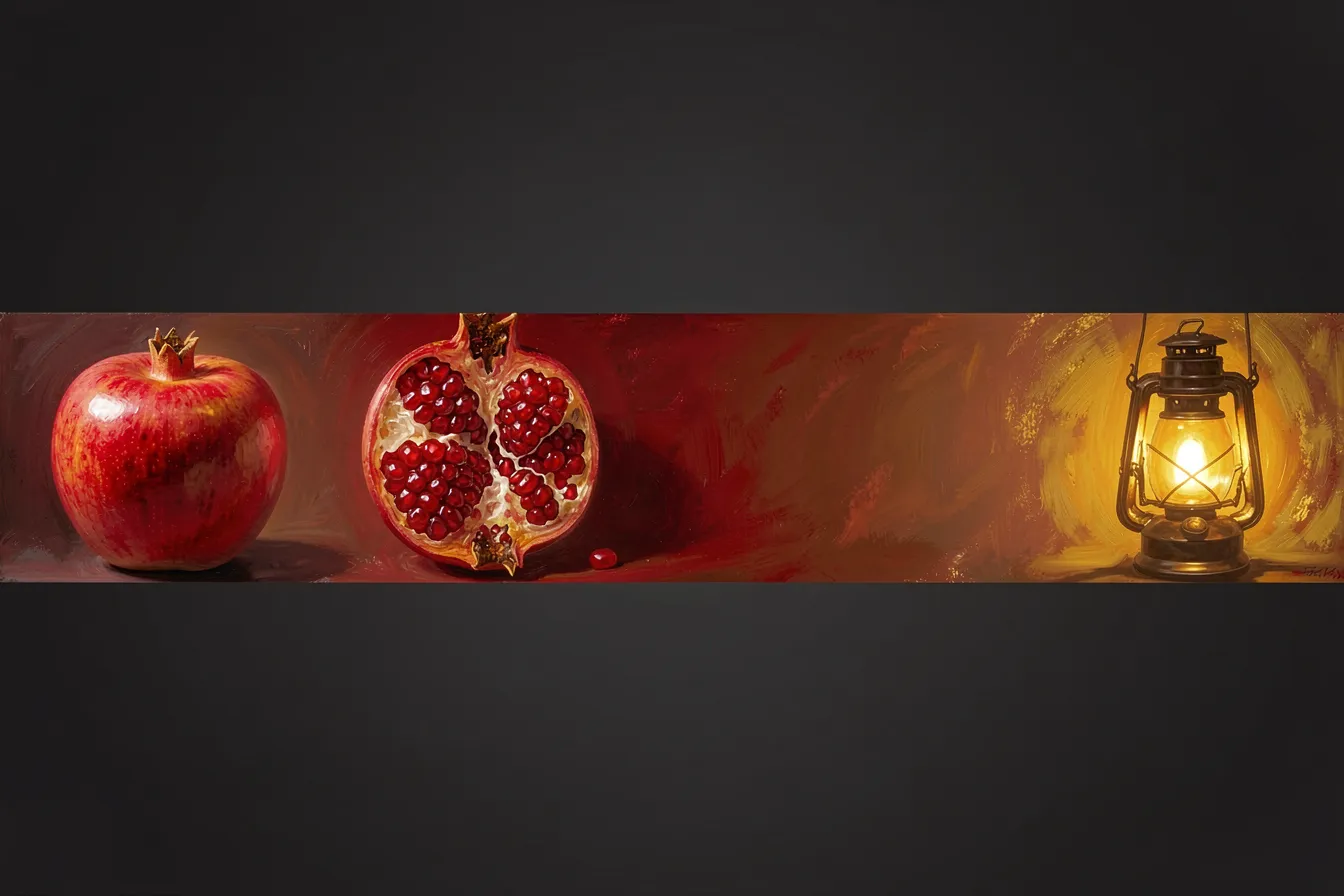
The important part: nearby points produce similar images. Move a short distance and a red apple becomes a slightly redder apple. Move further and it becomes a pomegranate, then a lantern, then something you have no word for. Because the space is continuous, there is no gap between any two images. You can always ask what sits halfway.
Walking between two prompts
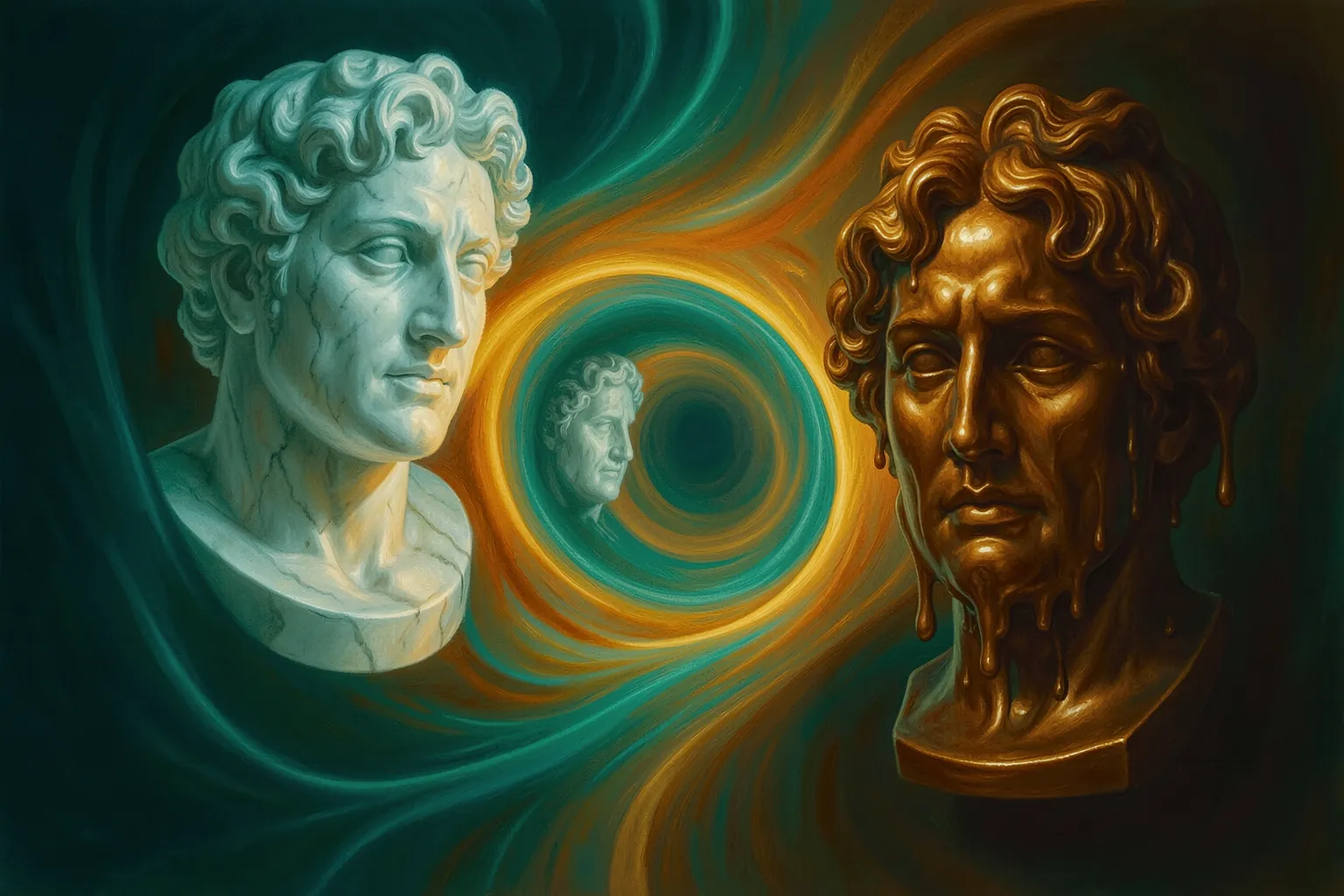
The simplest latent walk takes two prompts and crawls from one to the other. Encode “a marble bust of a Roman emperor” and “a weathered bronze diving helmet.” Generate not one image at each end but forty images spaced evenly along the line connecting them. Play them in sequence and the marble face slowly corrodes, sprouts rivets, and seals itself shut. No frame was drawn by hand. Each is a real generation, sampled from a coordinate the artist never typed.
Artists who do this seriously do not interpolate in a straight line. Straight lines through a high-dimensional space tend to pass through a murky, washed-out middle where the model is unsure of everything at once. The fix is spherical interpolation, or slerp, which curves the path along the surface of the space instead of cutting through its center. The difference is obvious on screen: slerp keeps each frame crisp and committed, while a linear walk goes grey and mushy around the halfway mark. It is the kind of small technical choice that separates a convincing piece from a blurry mess.
The seed is a second dial
You can hold the prompt perfectly still and walk the seed instead. Same words, different starting noise, and the image reorganizes itself — the cat turns to face the other way, the clouds rearrange, the whole composition shuffles while the subject stays. Mario Klingemann, one of the earliest artists to treat these models as an instrument rather than a toy, built entire works out of this: fix the concept, roam the noise, and let faces emerge and collapse in an endless unrepeating stream. His piece drifting through imagined portraits runs on exactly this principle.
Combine the two walks and you get a grid you can steer in two directions at once. Prompt interpolation on one axis, seed interpolation on the other. Artists sometimes map this grid to a controller or a mouse and perform it live, nudging the image through concept-space in real time like a visual synthesizer.
Why this counts as a medium, not a trick
A single generated image hides its own process. You see the result, not the thousand near-misses around it. A latent walk puts the process on display. It shows you the neighborhood, the gradient, the way the model thinks one thing is adjacent to another. That adjacency is where the art lives, and it is genuinely strange: the model has decided, from its training, that a jellyfish sits near a chandelier, that rust sits near autumn leaves. Walking those connections is a form of exploration no painter ever had access to.
The technique also rewards taste in a way prompting alone does not. Anyone can type two prompts. Choosing which two prompts sit far enough apart to be surprising but close enough to morph gracefully — that is a compositional decision. So is picking where to start and stop the walk, how fast to move, whether to loop it seamlessly or let it run open-ended. Refik Anadol’s large data sculptures lean hard on this, flowing through latent representations of millions of images so that the piece never repeats and never quite settles.

Where it gets hard, and where it gets ethical
Latent walks expose the model’s blind spots. Push a walk through concepts the model saw rarely and the frames stutter, warp, or snap discontinuously instead of flowing. The smoothness of a walk is a direct readout of how densely that region of the space was trained. Artists learn to feel these textures — the easy highways and the broken back roads — and some deliberately seek the broken ones, because that is where the machine produces things no human aesthetic would have chosen.
There is a harder question underneath. The space you are walking was built from scraped images, and a walk can drift straight through a living artist’s territory without you naming them. You might interpolate toward “lush botanical illustration” and land squarely in a style someone spent thirty years developing. The technique does not absolve you of that. The artists doing this work with care tend to train on their own material, or on licensed sets, so that the space they walk is one they have a right to be in. That choice does not show up in the final frames, but it is the difference between an instrument and a strip-mine.
Try the walk yourself
Start small. Pick two prompts you can picture clearly, generate the two endpoints, then ask for the midpoint and judge it. If it looks like honest progress between the two, extend to ten frames, then forty. Switch to spherical interpolation the moment the middle goes grey. The first time a walk flows cleanly from one idea into another, you stop thinking of the model as a vending machine and start hearing it as something you can play. Open the AI Art Designer tools and take a walk through the space — the interesting images are the ones between the obvious ones.
Images: AI-Designed
Dieser Beitrag ist auch verfügbar auf:
 English