Here is a problem every AI artist hits sooner or later. You have a specific thing in your head — your own face, a particular ceramic glaze, the exact mood of a childhood kitchen — and no combination of words gets the model to draw it. You type “vintage green enamel pot, soft morning light” for the twentieth time and the machine keeps giving you a stranger’s pot. The words are too blunt. The thing you mean lives below language.
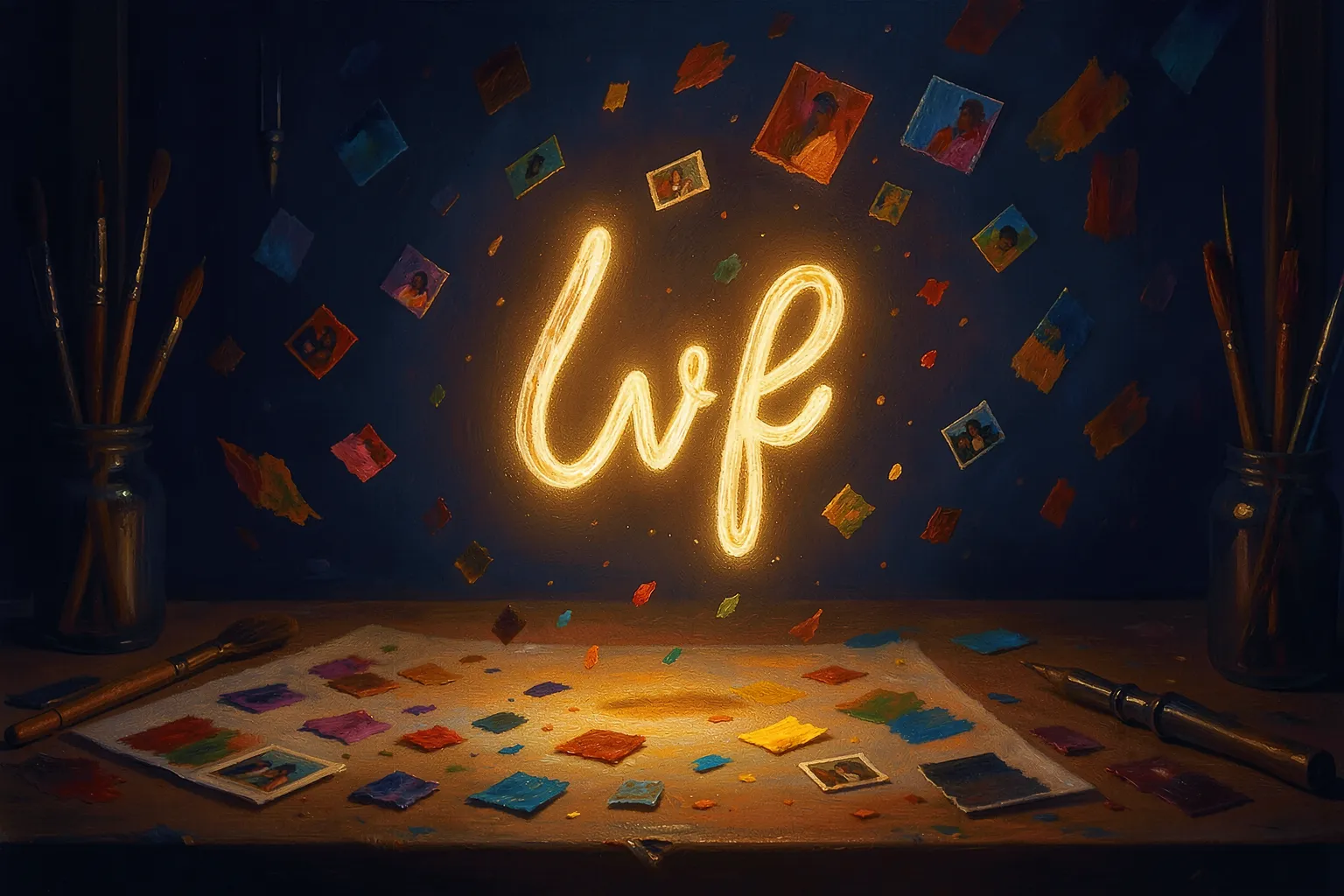
Textual inversion is the fix. It teaches the model one new word — a word that did not exist until you made it — and binds that word to a concept you supply as a handful of images. After training, you type your invented token into a prompt like any other word, and the model draws your thing. Rinon Gal and his co-authors introduced the method in a 2022 paper with a title that says the whole idea: “An Image is Worth One Word.”
What the model actually learns
Start with how a diffusion model reads a prompt. Every word gets turned into a vector — a long list of numbers — before the image model ever sees it. “Cat” is a point in that space. “Baroque” is another. The model has learned millions of these points during training, and it paints by steering toward them.
Textual inversion does something narrow and clever. It freezes the entire image model. It changes nothing about how the network paints. Instead it invents one fresh vector, hands it a placeholder name — people write it as something like <my-glaze> — and nudges that single vector around until prompts containing it reproduce your training images. You are not teaching the model to paint. You are finding the one word that already makes it paint the thing you want. The thing was always reachable; the method just locates the coordinates.
That is why the output of a training run is tiny. A LoRA file runs tens or hundreds of megabytes because it edits the model’s weights. A textual inversion embedding is often under 100 kilobytes — small enough to email, because all it stores is that one vector, a few thousand numbers and nothing else.

How a session actually goes
The practical recipe is short, which is part of the appeal. Gather three to five images of your subject. More is not always better — ten photos of your face from the same angle teach the model that angle, not your face. Vary the lighting, the crop, the background. Crop to the training resolution, usually 512 or 768 pixels square. Write a plain description of what stays constant.
Then you train, usually inside AUTOMATIC1111’s web UI or a notebook, and you wait. A single embedding takes somewhere between twenty minutes and a couple of hours on a consumer GPU, depending on how many steps you run. The dial that matters most is step count. Too few and the token stays vague. Too many and it overfits — it memorizes your exact training photos and refuses to budge, so “<my-glaze> on a spoon” just redraws your original pot. Most people save a checkpoint every few hundred steps and pick the one that generalizes before it locks up.
The reward for that patience is reuse. Once the embedding exists, it costs nothing to run. Drop the token into any prompt, combine it with others, scale its strength with the usual bracket syntax. An artist who has inverted their own signature palette can summon it in a line: a still life “in the style of <ndb-palette>,” a portrait, a landscape, all carrying the same color logic without a single adjective spent describing it.
Inversion, LoRA, or fine-tuning
These three get lumped together as “custom training,” and they are not the same tool. Full fine-tuning rewrites the model and needs real hardware and a real dataset. LoRA sits in the middle: it adds a small trainable layer, learns faster than full tuning, and is strong when you need the model to learn a new capability — a face it can render from any angle, a style with its own brushwork and composition.
Textual inversion is the lightest of the three, and its limit is honest. It can only point at concepts the model already half-knows how to paint. Ask it to render a texture or a color mood it has never seen anything like, and the single vector has nowhere to land. For a recognizable object or a coherent style, though, it is often all you need, and it composes beautifully. You can stack several embeddings in one prompt — your subject token, your palette token, a lighting token — and because each is just a word, they mix the way words do.
Why it still matters in 2026
Newer methods are flashier. IP-adapter steers from a reference image with no training at all. DreamBooth and its descendants bind a subject into the weights for sharper fidelity. So why keep a technique from 2022 around?
Two reasons. The files are portable in a way nothing else matches — a 50-kilobyte embedding is a concept you can trade, archive, or version like a brushstroke, and a studio can keep a whole library of them. And the method is transparent. You can see exactly what it changed: one word, one vector, the rest of the model untouched. For an artist building a consistent visual identity across dozens of pieces, that control is the point. You are not hoping the model remembers your style. You have written it down as a word and you own the word.
There is a quieter argument too. Textual inversion treats a visual idea as vocabulary. Give the thing a name and it stops being a lucky prompt you have to rediscover each session. It becomes a word you can say on purpose, every time. That is closer to how real craft works than most of the generative pipeline, and it is why the technique keeps earning its place in artists’ toolkits.
Want to turn your own references into reusable concepts? Start experimenting with custom tokens and image-driven editing at ai-art-designer.com.
Images: AI-Designed
Dieser Beitrag ist auch verfügbar auf:
 English