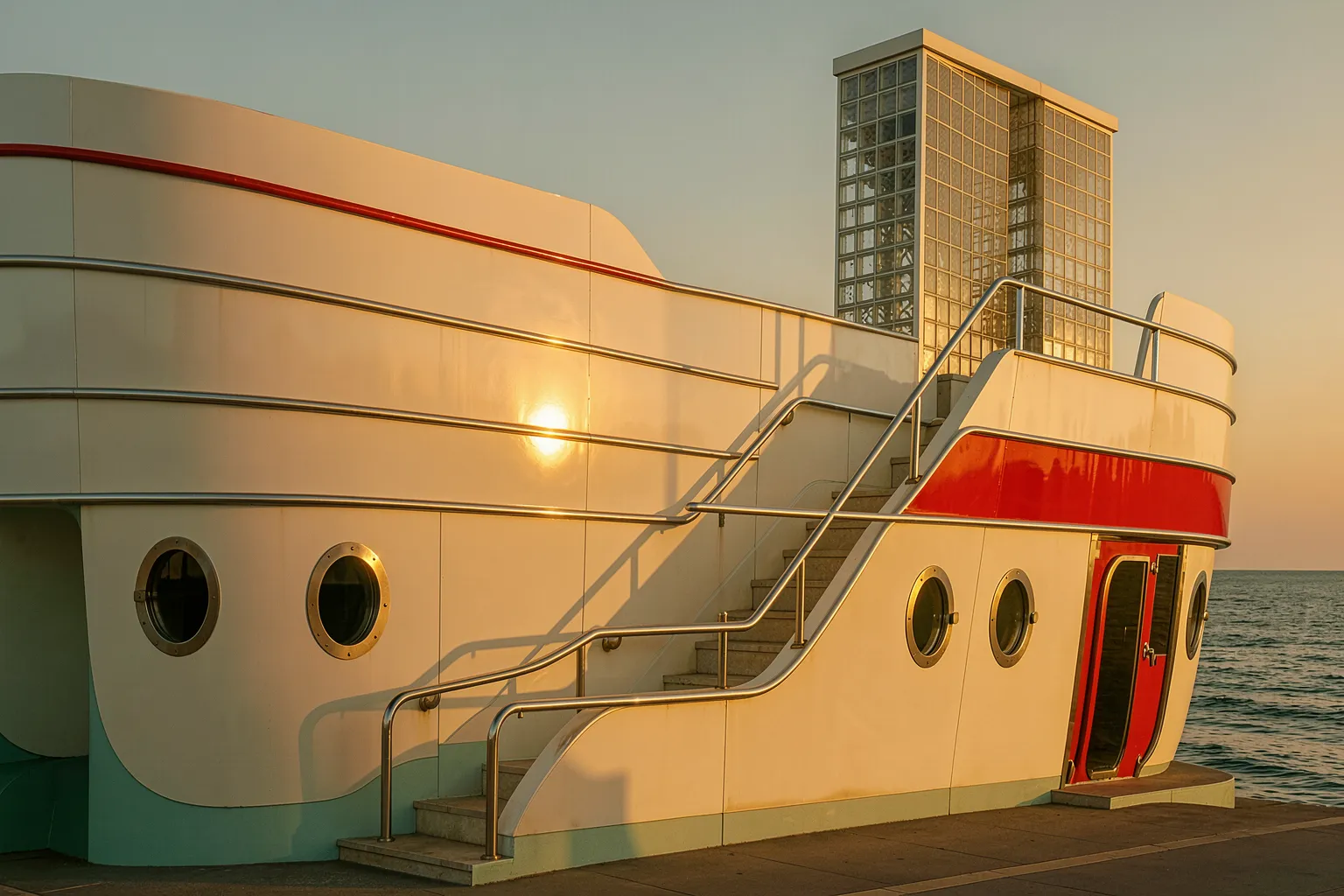
Streamline Moderne always looked like it was moving even when it stood still. Rounded corners, long horizontal bands, a porthole or two, a chrome rail curving around a stair — the style borrowed the shape of speed from ships, trains and aircraft and pasted it onto diners, gas stations and radios that never went anywhere. It peaked fast, roughly 1933 to 1940, then the war ended the party. Now generative image tools are giving it a strange second life, and the results say as much about the machines drawing them as about the 1930s.
I’ve been feeding this style through text-to-image models for weeks. Some renders nail the mood on the first try. Others expose exactly where the training data thins out. Both are worth talking about.
What made a building look “streamlined”
The vocabulary is small and strict, which is partly why AI handles it well. Curved corners instead of sharp ones. Long, unbroken horizontal reveals — usually three parallel lines running around the facade like racing stripes. Smooth stucco or enameled steel, painted white or cream. Glass block for light without windows. Nautical touches: portholes, pipe railings, the odd flagpole standing in for a ship’s mast. Raymond Loewy, Norman Bel Geddes and Walter Dorwin Teague pushed the same logic onto everything from locomotives to pencil sharpeners. Bel Geddes drew teardrop cars and ocean liners nobody built; Loewy actually shaped the Pennsylvania Railroad’s S1 locomotive and the Coldspot refrigerator.
The real buildings are fewer than people think. The De La Warr Pavilion in Bexhill-on-Sea, finished in 1935 by Erich Mendelsohn and Serge Chermayeff, is the great one — a welded steel frame, a spiral stair wrapped in glass, a seafront terrace that still works. London’s Hoover Building on Western Avenue leans more Art Deco but carries the streamlined swagger. In the States you get the Coca-Cola bottling plant in Los Angeles, dressed up as an ocean liner complete with a promenade deck, and the lost Pan-Pacific Auditorium with its four upswept pylons. That’s a short list to train a model on.
Where the models shine
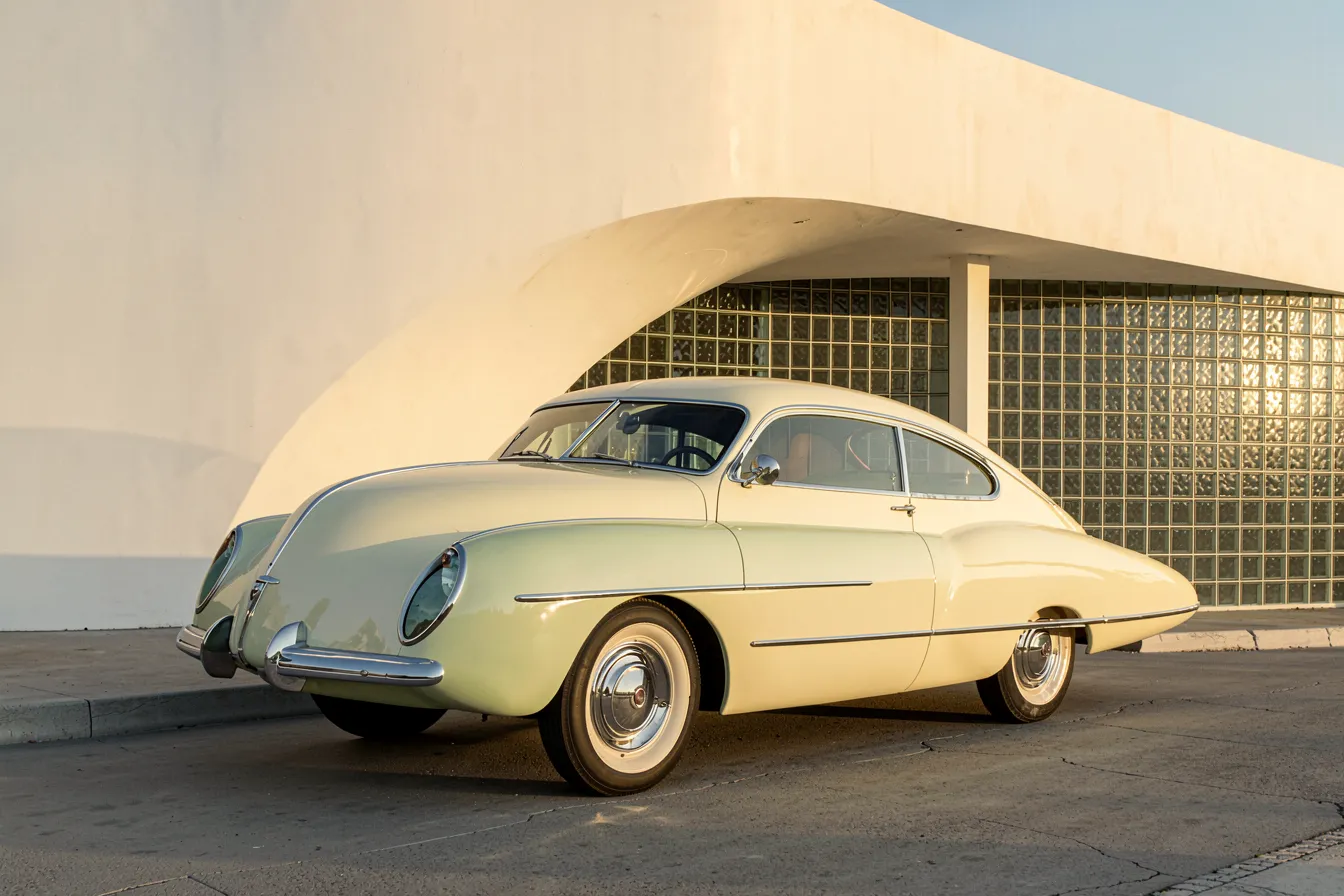
Give a diffusion model a prompt like “Streamline Moderne transit terminal, curved white facade, three horizontal reveal lines, glass block, chrome railings, golden hour” and it usually delivers something convincing. The style’s discipline helps here. Because the grammar is so repetitive — curve, band, porthole, repeat — the model doesn’t have to invent much. It has clearly seen enough diners and 1930s posters to reproduce the palette: cream, seafoam, a slash of red, chrome catching low sun.
It also fills a gap that history left open. Bel Geddes and his peers drew hundreds of streamlined fantasies that never got built — floating airports, teardrop buses, a nine-decked airliner called the Air Liner Number 4. Those renderings lived as pencil sketches and airbrush illustrations. Feeding their descriptions into an image model produces something the 1930s could only imagine on paper: a photographic-looking version of a future that was always fictional. There’s a real pleasure in seeing Bel Geddes’ teardrop car parked, in sharp light, outside a building that also never existed.
Where it falls apart
Push past the postcard shot and the cracks show. Ask for a floor plan or a section and the model hands back a facade wearing a plan’s clothes — lines that look technical but describe nothing. Streamline Moderne was an engineering aesthetic; it claimed structural honesty it rarely had, since most of those curves were plaster over ordinary brick. The models inherit the bluff. They render the skin beautifully and have no idea what holds it up.
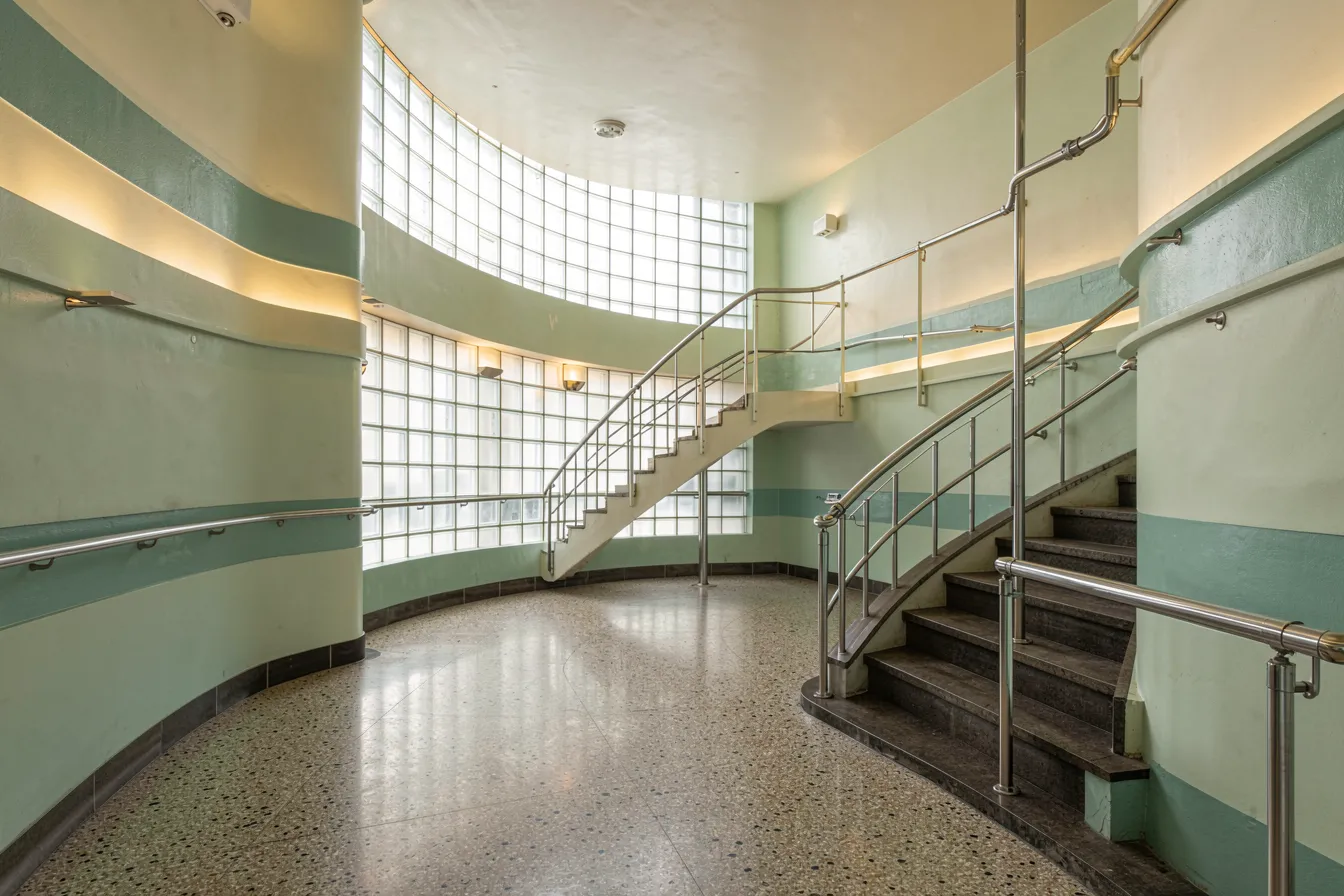
Text is the other giveaway. So much of the style lived in signage — the vertical hotel sign, the neon script over a diner, the speed lines flanking a brand name. Diffusion models still mangle letters, so a “streamlined” storefront often carries a sign that reads like melted alphabet soup. And the models over-associate. Ask for a streamlined interior and you frequently get Miami pastels and palm trees bolted on, because the training set can’t cleanly separate Streamline Moderne from the Tropical Deco of South Beach. They’re cousins, not twins, but the machine treats them as one.
A style that suits the machine
There’s an odd fit between this particular style and this particular tool. Streamline Moderne was itself a design of surfaces — form applied to hide the mechanism, speed implied rather than achieved. A diner shaped like a locomotive doesn’t move. A radio shaped like a raindrop isn’t more aerodynamic. The style sold the feeling of the machine age while the actual machinery stayed hidden inside the box.
Generative AI works the same way. It produces a persuasive surface and hides the mechanism completely. When you ask it for a streamlined building, you get the look of engineering with none of the engineering, exactly what Loewy and Bel Geddes were selling in 1936. The medium and the message rhyme. That’s not a knock on either. It’s just a neat piece of luck that the most surface-obsessed style of the last century found its natural collaborator ninety years later.
Using it well
If you want good streamlined renders, be specific and stay period-honest. Name the reveal lines and the glass block. Ask for enameled steel, not just “white.” Specify a low sun — the style depends on raking light to catch its curves. Reference a real building (the De La Warr Pavilion is a reliable anchor) rather than the vague word “retro,” which drags the model toward 1950s diners and chrome-heavy kitsch. And drop the signage from the prompt unless you plan to add the lettering yourself later; you’ll save yourself a gallery of gibberish.
Treated this way, the style becomes a fast, cheap way to explore a design language that only ever got a handful of buildings. The 1930s ran out of money and then ran into a war. The renderings are a chance to see what the streamliners were reaching for, minus the plaster and the bluff — a machine-age dream finally drawn by a machine.
Want to test it yourself? Try a few Streamline Moderne prompts in the AI Art Designer and see how far the curves take you.
Images: AI-Designed
Dieser Beitrag ist auch verfügbar auf:
 English