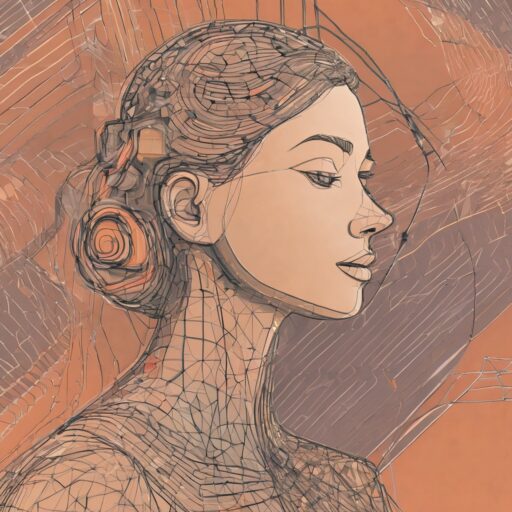

Ask ten AI artists what gives their work a recognizable look and most will not point to a prompt. They will point to a model. Not one of the famous base releases, but a private blend they cooked at home by pouring two or three checkpoints into each other until the output started to feel like theirs. This is model merging, and it is one of the least glamorous and most consequential crafts in generative art.
A checkpoint is the whole painter: billions of weights that decide how a model renders skin, fabric, metal, fog, a horizon line. Merging mixes those weights directly. No training run, no dataset, no GPU rental by the hour. You take Model A and Model B, choose how much of each to keep, and save the result as a new file. The surprising part is that it works at all. Average two sets of weights and you usually get something coherent, not noise.
Why mix models instead of training one
Training a checkpoint from scratch is a research project. Fine-tuning one on your own images is cheaper but still wants a clean dataset, careful settings, and hours of compute you can waste in a single bad run. Merging skips all of it. The cost is a few minutes and some disk space.
That low cost changes how people experiment. An artist who likes the anatomy of one model but the lighting of another does not have to choose. They blend, generate a test grid, nudge the ratio, blend again. The loop is fast enough to treat as sketching. You are not tuning a neural network so much as mixing paint, and the muscle memory that develops is closer to a colorist’s than an engineer’s.
The results fill the model-sharing sites. A large share of the most downloaded checkpoints on public hubs are not original trainings at all. They are merges of merges of merges, lineages so tangled that nobody can fully reconstruct what went into them. That is both the charm and the headache of the practice.

The recipes, from crude to surgical
The blunt method is a weighted sum. Keep 60 percent of Model A and 40 percent of Model B across every weight in the file. It is one slider, and it is how most people start. Push the slider around, watch the look drift, stop where it clicks.
A smarter method notices that a diffusion model is not one blob. It has layers, grouped into blocks, and different blocks do different jobs. Early blocks tend to govern broad composition and pose. Later blocks lean toward texture and fine detail. Block merging lets you set a different ratio for each one. Take composition from the model that frames a scene well, pull surface detail from the model with the skin and fabric you like, and leave the middle somewhere in between. It is tedious. It is also where merging stops being a lottery and starts being a tool.
Then there is add-difference merging, which works by subtraction. Take a fine-tuned model, subtract the base it was trained on, and you are left with roughly what the tuning added, the delta. Add that delta onto a third model and you transplant a trait without dragging the whole donor along. Artists use it to move a specific quality, a particular rendering of light, say, from one lineage into another that otherwise has nothing to do with it.
What breaks, and how you know
Merging is forgiving until it isn’t. Blend two models that disagree too sharply and the output goes soft and gray, every image hedging between two styles it cannot commit to. Push a block ratio too far and hands fall apart, or text in the scene turns to gibberish, or faces acquire that waxy sameness that screams machine. The model does not warn you. It just quietly gets worse, and you only catch it by looking.
So the real skill is the test grid. Fix a seed, write a handful of prompts that stress the things you care about, and generate the same set after every merge. Portraits for anatomy. A busy street for composition. Something with lettering if your work needs clean type. Line them up and compare. The artists who get good merges are not the ones with the best intuition about weights. They are the ones who look hardest at the output and throw away the versions that almost work.

A house style you actually own
Here is why any of this matters beyond the tinkering. Everyone has access to the same base models. If your only input is a prompt, your ceiling is whatever millions of other people can also reach with that prompt. A custom merge moves the floor. It bakes your preferences into the weights so that even a lazy prompt lands closer to your aesthetic, and a careful one goes somewhere few other people can follow.
Several working illustrators now treat a private merge as their primary instrument, updated the way a photographer updates a preset pack. They keep a short chain of their own blends, each tuned for a kind of job, and they guard the recipe. It is not glamorous intellectual property. It is a text file of ratios. But it is the difference between sounding like the default voice of a model and sounding like yourself.
The messy ethics of a blended lineage
Merging inherits every argument about the models that go into it, and then adds its own. If one ingredient was trained on scraped art without consent, the merge carries that forward, now harder to trace. License terms collide: blend a permissive model with a restrictive one and the result sits in a gray zone that most hobbyists ignore and most lawyers would not. The community mostly runs on trust and credited recipes, which works until it doesn’t.
None of that cancels the craft. It frames it. Merging is the clearest proof that generative art has a middle layer between the prompt and the picture, a place where real choices get made and real taste shows. The people doing it well are not asking a model for an image. They are building the painter first, then asking.
Want to see what a custom look can do before you build your own? Experiment with styles and generate your own pieces at ai-art-designer.com.
Images: AI-Designed
Dieser Beitrag ist auch verfügbar auf:
 English