A painting walks into an auction house. Is it a Rubens or a workshop copy worth a fraction as much? For four centuries that question belonged to a tiny priesthood of connoisseurs — scholars who had looked at ten thousand canvases and trusted their eye. Now a neural network wants a vote. And the art world cannot decide whether to hand it one.
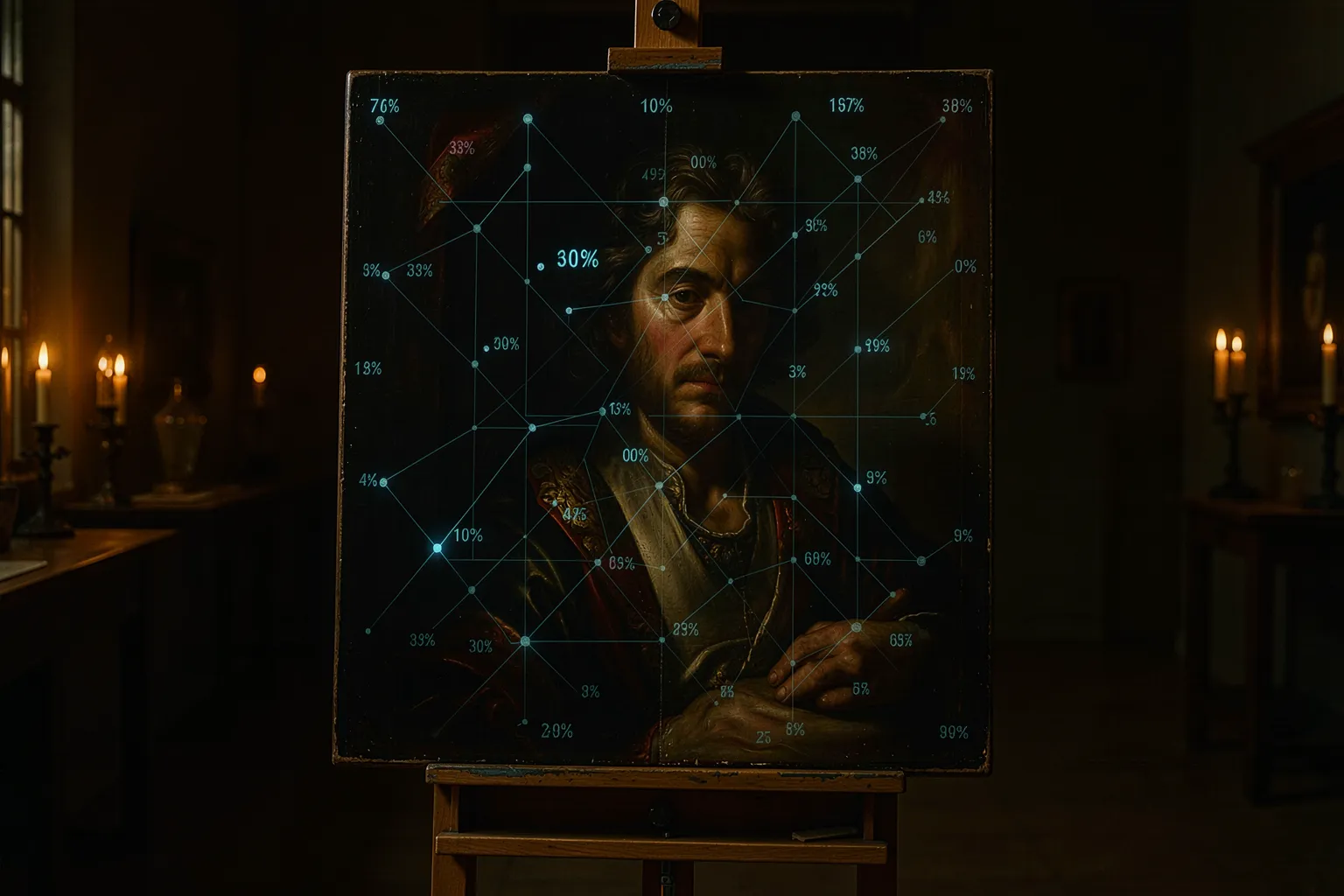
The company forcing the issue is Art Recognition, a Swiss outfit founded in 2019 near Zurich. It trains convolutional neural networks on an artist’s authenticated work, then scores a disputed picture on how closely its brushwork, texture, and tonal rhythm match. The output is blunt: a percentage. In 2021 the system gave a contested painting a 91% probability of being authentic. Headlines followed. So did the fights.
What the algorithm actually looks at
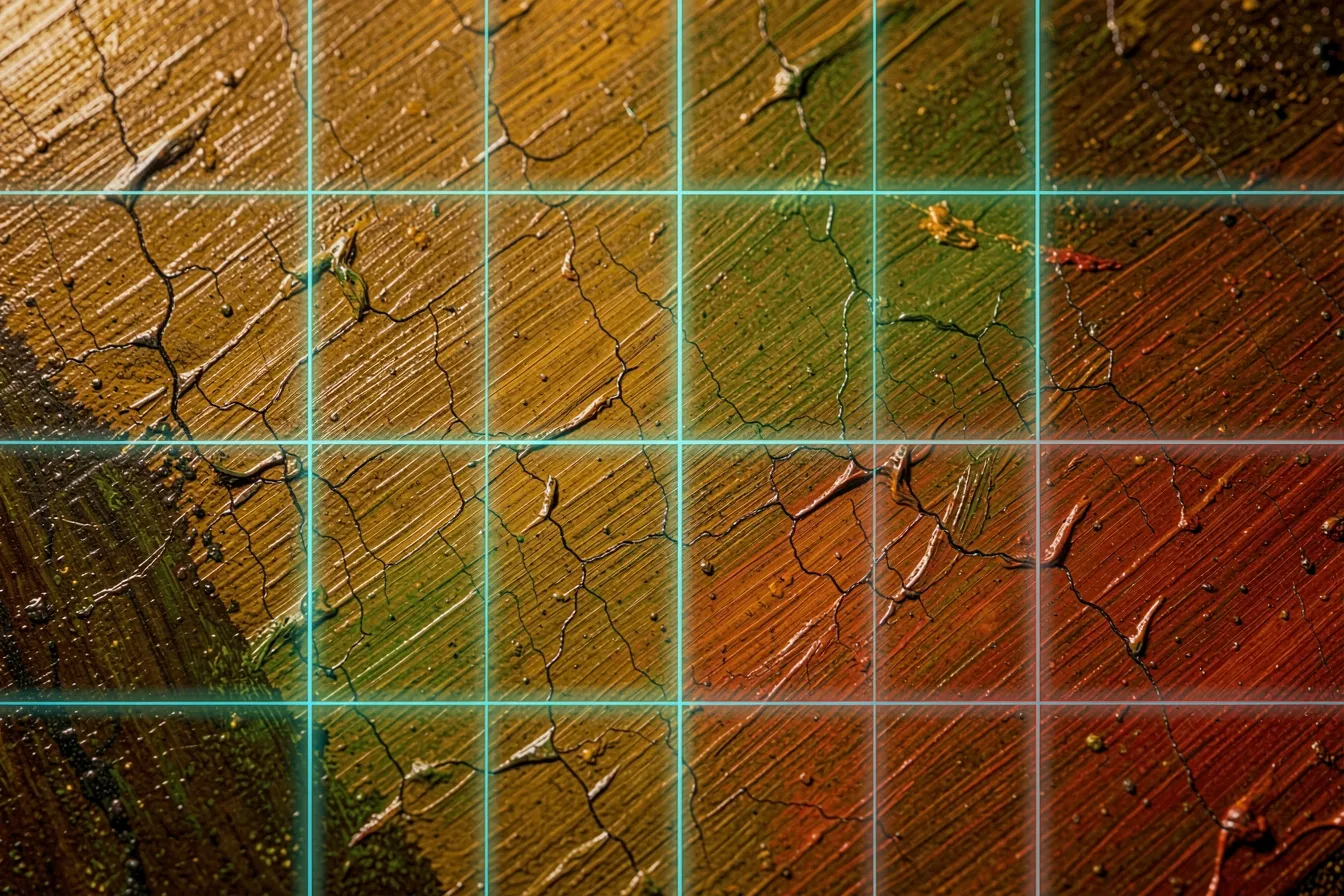
Forget the romance of the trained eye for a second. Art Recognition’s model does not care about provenance papers, exhibition history, or who owned the thing in 1780. It reads pixels. The network breaks a high-resolution scan into small patches and asks, for each one, whether the handling looks like the master or like someone imitating the master. Brushstroke pressure, the way paint pools at an edge, the micro-rhythm of a repeated gesture — these leave a statistical fingerprint that is genuinely hard to fake, because a copyist is concentrating on the image, not on reproducing an unconscious motor habit.
That patch-level approach is the clever part, and also the weakness. On a 2025 Rubens candidate, the results came back mixed: most patches read as authentic, a handful did not. So what is the verdict on the whole painting? A Rubens with studio help? A later retouch over a real base? The number does not say. It flags where the handling wavers and leaves the interpretation to humans — which is exactly the job connoisseurs thought the machine was going to take off their hands.
Why old masters are the hardest case
Caravaggio is the nightmare scenario, and a useful one. He painted perhaps sixty surviving works in a short, violent life, and spawned a century of imitators so skilled that the category “Caravaggesque” is its own field. A small documented body of work plus an enormous afterlife of imitation is poison for any statistical model — you are asking it to learn a style from barely enough examples, then distinguish the master from followers who studied him obsessively. Train on too little and the network becomes confident about noise. That is not a hypothetical failure mode; it is the structural condition of the entire old-master market.
Rembrandt sits at the other end. The Rembrandt Research Project spent decades demoting and re-promoting paintings, and the attributed corpus is large and well-photographed. A model has something to chew on. But even there, the hard cases are hard for the same reason they are hard for people: a workshop picture painted under the master’s eye, with his corrections, is a real object that sits between categories no clean label can hold.
The connoisseurs push back, and they are not wrong
In March 2026, CNN ran a piece with a title that captured the standoff: art historians and AI may not agree. The complaints from scholars are specific and fair. The training sets are small and often skewed toward whatever is easy to photograph. The models are proprietary — you get a percentage, not a reason, and “87% authentic” is not an argument you can take into a scholarly dispute. And confidence is not correctness. A network trained on 150 Caravaggios it was told were real will cheerfully score a clever forgery at 80% if the forger copied the right habits.
There is a sharper objection underneath. Attribution has never been a purely visual problem. It braids together the eye, the documents, the pigment analysis, the dendrochronology of the panel, the gap in a collection’s records. Art Recognition reads only the surface. Treating its number as a verdict rather than one instrument on the bench is where the trouble starts — and where a nervous market, desperate for a clean yes or no, is most tempted to overreach.
Follow the money, because the market already has
The reason this matters beyond the seminar room is simple. An attribution can swing a painting’s value by a factor of a hundred. A “circle of Rubens” at a regional sale and an autograph Rubens at Christie’s are the same object with a different sentence attached. That gap is the whole game, and it is why an AI percentage is so dangerous and so attractive at once. Sellers want the high number. Buyers want deniability. Insurers want a figure to underwrite. Everyone would love to outsource the risk to a model that cannot be sued and does not hedge.
Auction houses have mostly kept the technology at arm’s length in their public catalogues, and that caution is telling. They know a disputed attribution is survivable; a lawsuit over one is not. So the AI verdict tends to show up where the stakes are murkier — in the trade below the headline lots, in the arguments between a hopeful owner and a doubtful scholar, in the press release that says “AI confirms” when what the model said was closer to “probably, with caveats.”
A tool, not an oracle
The honest read on where this lands: AI authentication is real, it is already in use, and it is most useful exactly when it is treated as the least authoritative voice in the room. As a triage tool — flagging the hundred paintings in a storeroom worth a human second look — it earns its keep. As a tie-breaker that overrules a careful scholar, it is a liability dressed as objectivity. The percentage feels like proof precisely because it hides its reasoning, and that feeling is the thing to distrust.
What the old masters are teaching the machine, then, is humility it was not built to have. A Caravaggio attribution is not a classification problem with a hidden right answer. It is a judgement, made under uncertainty, by people willing to be wrong in public. The network can sharpen that judgement. It cannot replace the willingness to own it.
Curious how far AI can push the visual edge — on new work, not four-hundred-year-old canvases? Explore what our generative tools can do at ai-art-designer.com.
Images: AI-Designed
Dieser Beitrag ist auch verfügbar auf:
 English