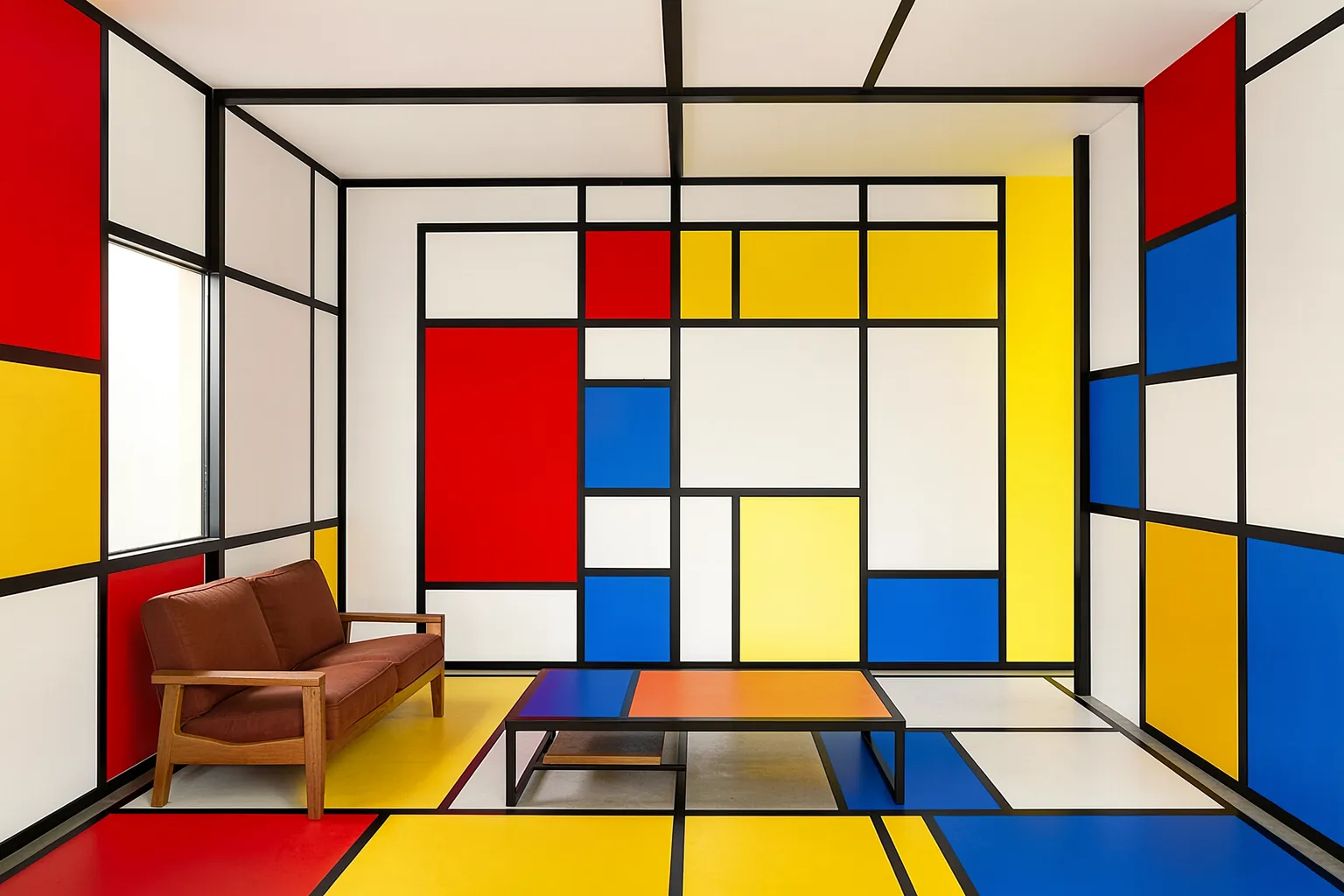
De Stijl stripped design to its bones. In 1917, Piet Mondrian, Theo van Doesburg, and Gerrit Rietveld chased a radical idea: reduce art to straight lines, right angles, and three primary colours. A century later, AI image tools now speak that language fluently. Feed a model the grid, the red-yellow-blue palette, and the black scaffolding, and it generates room after room of pure geometric order.
This matters because De Stijl was never just a look. The movement argued that clean geometry could reorganise how people live. AI lets designers test that claim faster than any studio ever could. You describe a hallway, a facade, or a chair, and the machine returns a Neo-Plastic version in seconds.
Why De Stijl Suits the Machine
Generative models love rules, and De Stijl runs on them. The style forbids curves, diagonals, and mixed tones. It permits only horizontals, verticals, and flat blocks of red, yellow, blue, black, white, and grey. Those hard constraints give a diffusion model a narrow, well-defined target.
Compare that to a vague brief like “cosy interior.” The model guesses wildly and often disappoints. Ask instead for “a De Stijl living room, asymmetric grid, primary blocks, black dividing lines,” and the output snaps into focus. The tighter you write the rule, the sharper the result.
From Mondrian’s Canvas to Living Rooms
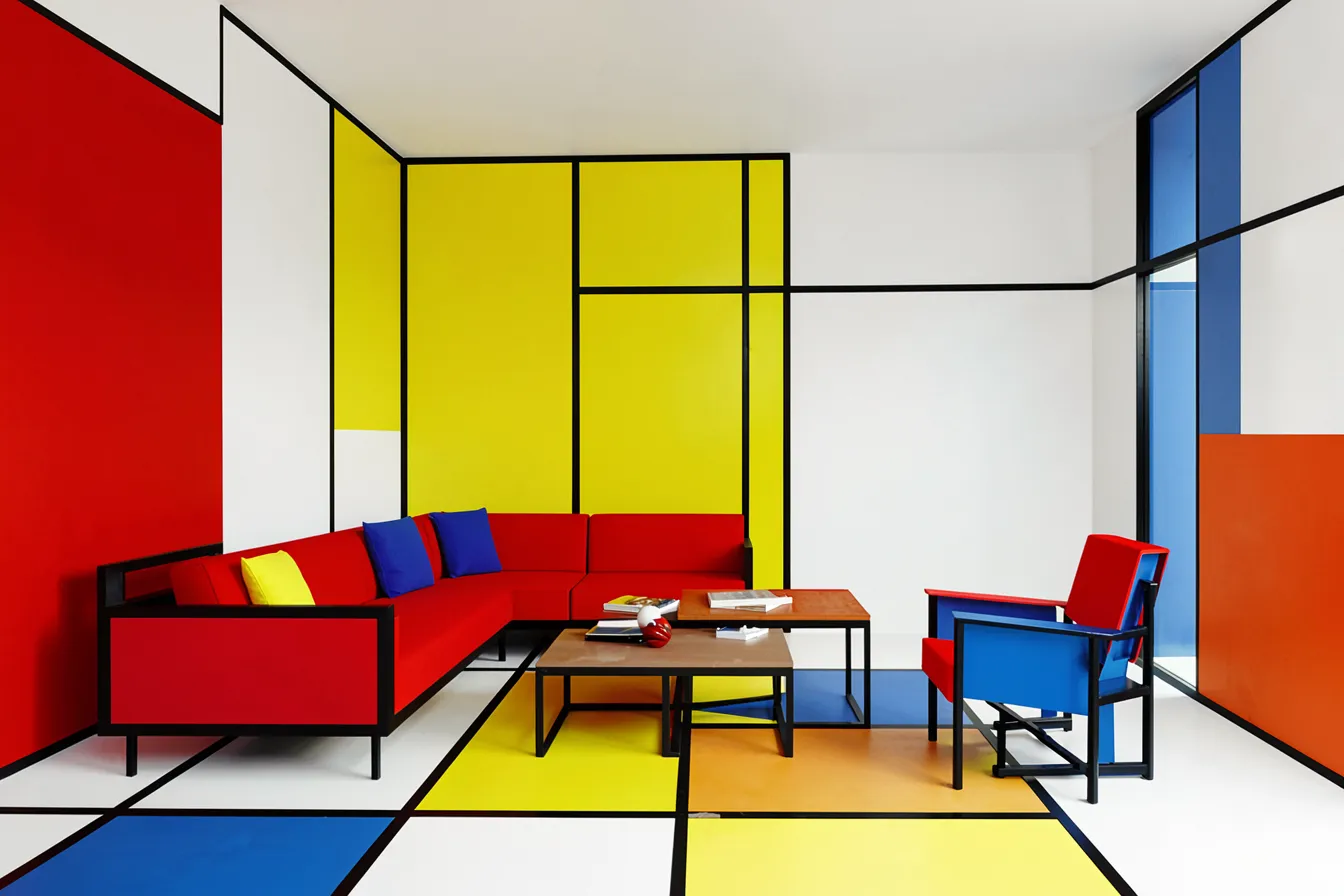
Rietveld already proved the leap from painting to space. His 1924 Schröder House turned Mondrian’s flat grid into walls, planes, and sliding partitions. His Red and Blue Chair rebuilt a canvas as furniture you can sit in. AI now retraces that path on demand.
Designers use the tools three ways:
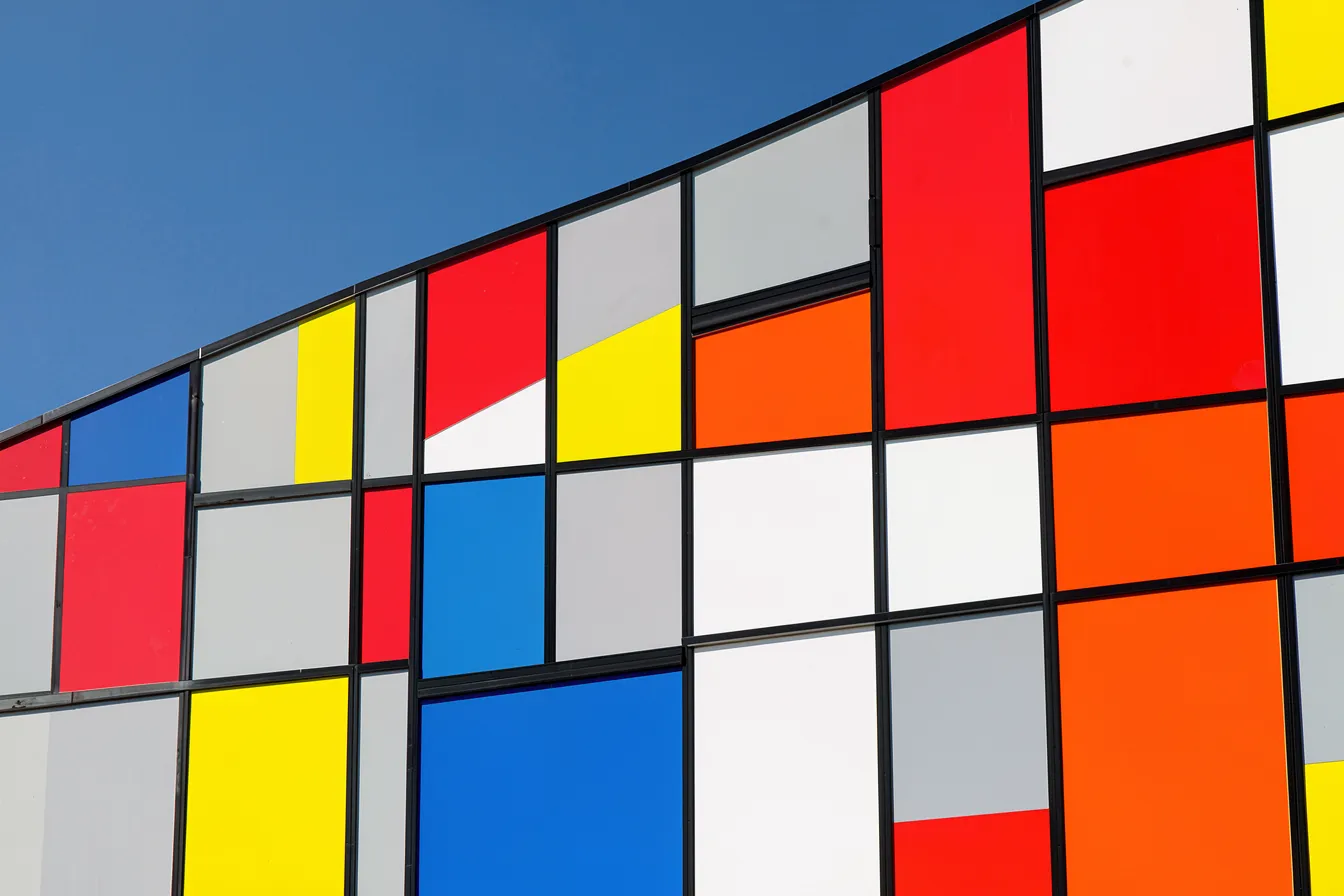
- Rapid facades. Generate dozens of Neo-Plastic building fronts, then pick the strongest composition.
- Furniture studies. Reskin a plain chair or shelf into primary-colour blocks before any CAD work begins.
- Colour zoning. Test how a red wall, a yellow niche, and a blue floor balance across a whole floor plan.
Each experiment costs minutes, not weeks. The designer edits the prompt, not the physical mockup.
Where AI Gets De Stijl Wrong
The tools still stumble. Models often sneak in a diagonal, a gradient, or a fourth colour that breaks the doctrine. They soften the black lines into grey smudges. They round corners that Mondrian would have fought to keep square.
Good operators correct this by naming the forbidden moves. Write “no curves, no gradients, no diagonals, flat colour only,” and the model behaves. The discipline of De Stijl becomes the discipline of the prompt. You direct the machine like a strict art teacher.
A Living Style, Not a Museum Piece
Critics worry that AI turns De Stijl into a novelty filter. That fear misreads the tool. A filter copies a surface; a good prompt rebuilds the logic. When a designer specifies asymmetric balance, off-centre weight, and rhythmic spacing, the model engages the movement’s real grammar.
That grammar still solves modern problems. Open-plan homes need clear visual zones without clutter. De Stijl offers exactly that: colour and line that guide the eye and split space cleanly. AI simply hands designers a hundred fast drafts to refine.
Try the Grid Yourself
De Stijl rewards anyone who respects its rules. Start with a simple brief, forbid the wrong moves, and iterate until the grid sings. The machine handles the drafting; you supply the judgement.
Want to reimagine a classic style with AI, from Mondrian’s grid to your own space? Explore the tools and galleries at ai-art-designer.de and start composing your own Neo-Plastic world.
Images: AI-Designed