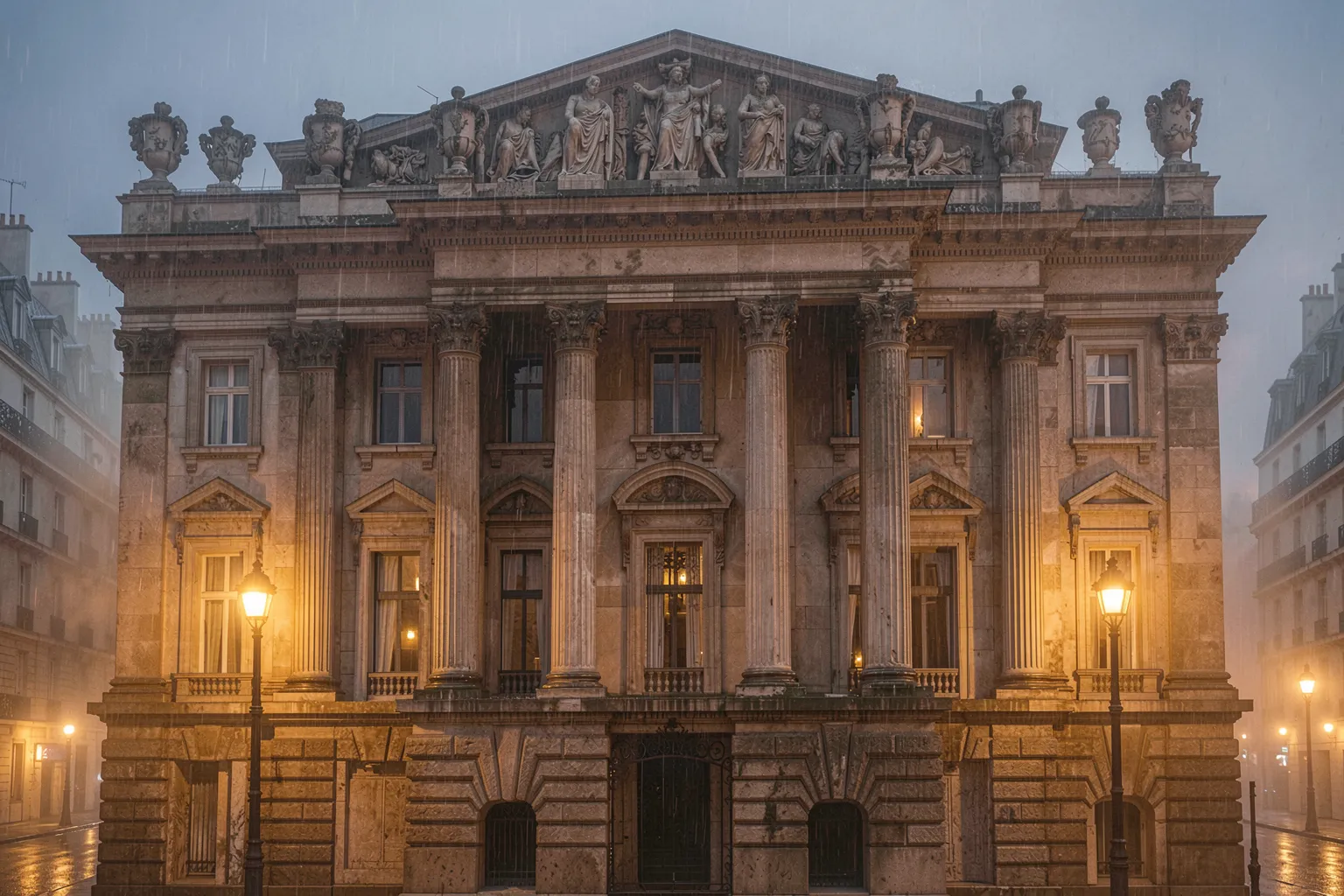
Beaux-Arts buildings were never shy. They were built to stop you on the sidewalk — a wall of paired columns, a cornice heavy enough to cast its own shadow, a roofline crowded with urns and allegorical figures who seem to be arguing about something. Charles Garnier’s Paris Opera. Grand Central Terminal. The old Pennsylvania Station, before the wrecking crews got to it in 1963. These are buildings that spend ornament the way a nouveau-riche banker spends money: all of it, at once, where everyone can see.
So what happens when you hand that language to a generative model? I spent a week feeding Beaux-Arts prompts into current image tools, and the results are more revealing than I expected — about the style, and about the machine.
A style built on rules, which the machine half-remembers
Beaux-Arts isn’t a vibe. It’s a curriculum. The École des Beaux-Arts in Paris drilled students for most of the 19th century in a strict grammar: symmetry about a central axis, a hierarchy of parts, a rusticated stone base holding up a lighter, more delicate upper floor, and a parti — the big organizing idea you could sketch in ten seconds. Composition came before decoration. You earned the garlands.
Generative models get the decoration right and the grammar wrong. Ask for a Beaux-Arts facade and you’ll get columns, pediments, swags, keystones — the whole vocabulary, rendered in convincing limestone. Look closer and the sentences fall apart. Columns land off the structural grid. A pediment floats above windows that don’t align with it. One famous building type, the triumphal-arch entrance, comes out with the arch springing from thin air because the model learned the shape of an arch without learning that an arch has to push against something.
That split tells you what these systems actually learned. They absorbed the texture of Beaux-Arts from thousands of photographs. They never sat through the École’s composition exercises, so the underlying logic — the reason a building holds together — stays out of reach.
Where it genuinely shines
Credit where it’s due. For mood and material, the models are frighteningly good. A rainy evening on a Haussmann boulevard, gaslight glinting off wet stone, the facade receding into fog — that image comes out gorgeous on the first try. AI has clearly eaten a century of architectural photography, and it hands back the romance of these buildings without flinching.
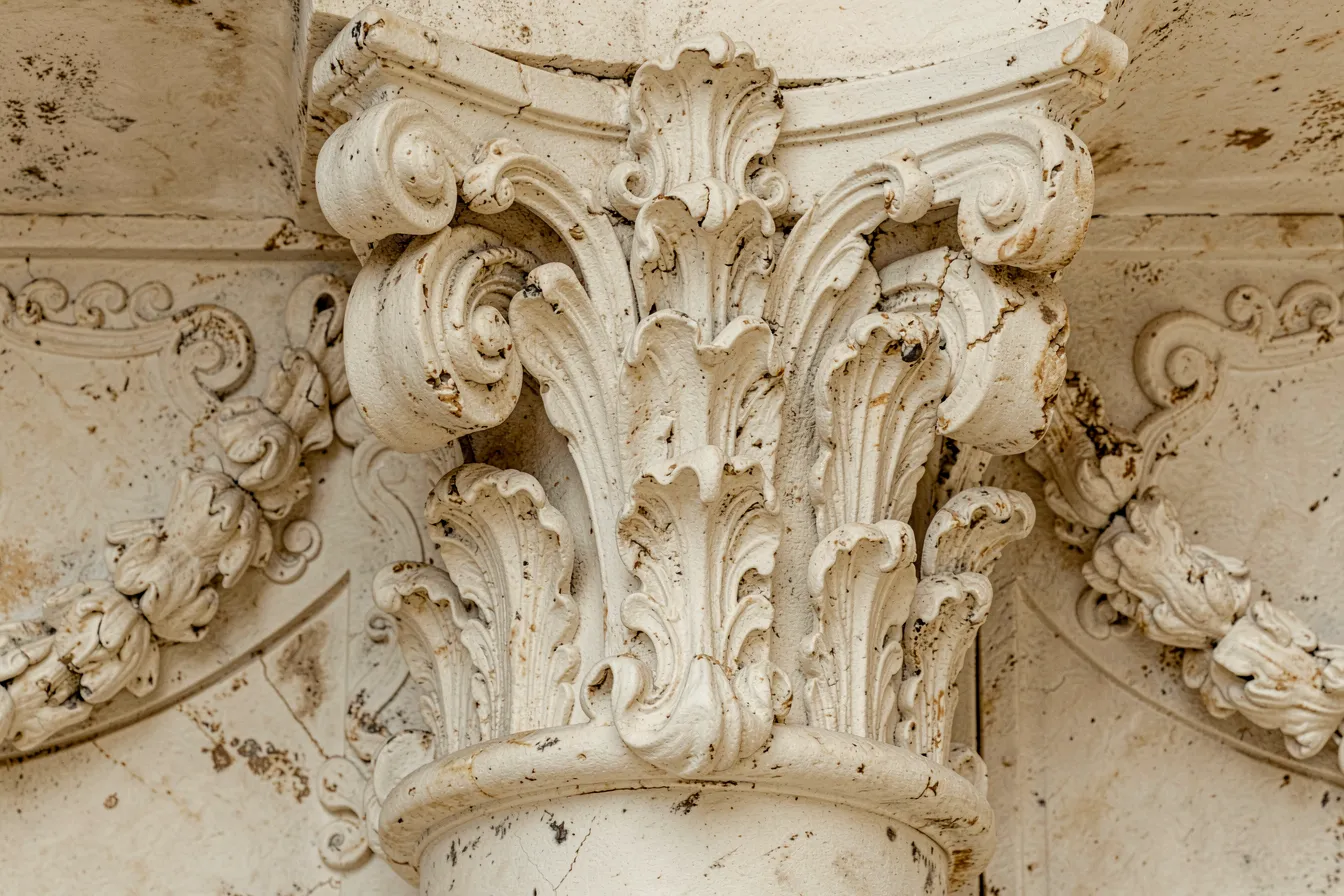
Ornament, taken on its own, is another strength. Need a cartouche, an acanthus-leaf capital, a cast-iron balustrade pattern? The model will invent fifty variations in a minute, and a good share of them would pass on a real building. Designers I’ve talked to have started using exactly this — not to design a whole facade, but to generate a wall of ornamental options, then pull the three that work and refine them by hand. The machine as a very fast, slightly drunk apprentice.
- Atmosphere: lighting, weather, patina, the sense of a building that has stood for 120 years.
- Detail libraries: capitals, consoles, medallions, ironwork — generated in bulk, curated by a human.
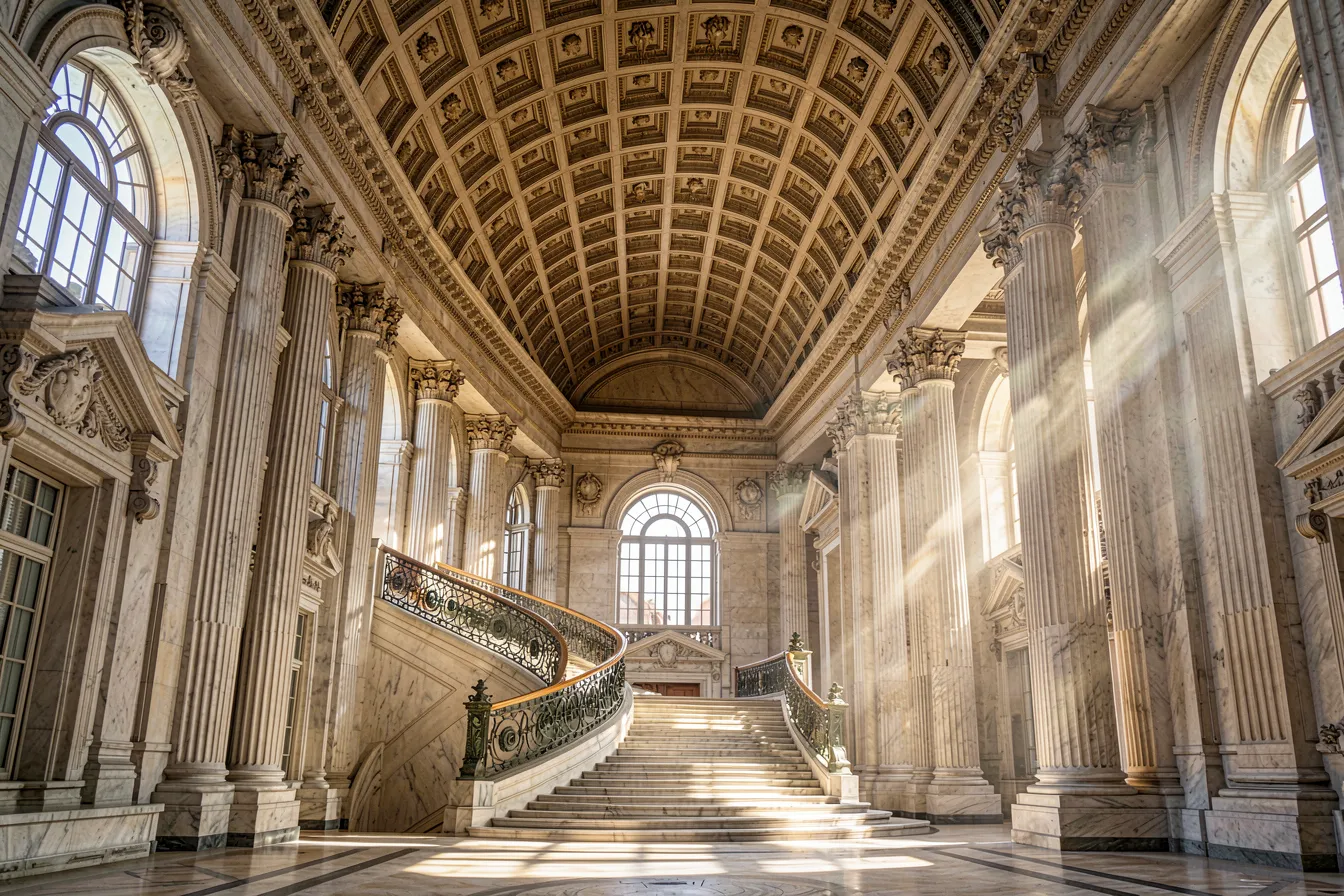
- Interiors: grand staircases and vaulted halls, where lavish surface matters more than load paths.
- Lost buildings: reconstructing the demolished, like Penn Station, from photos and drawings.
That last one is quietly moving. Penn Station’s great waiting room, modeled on the Baths of Caracalla, has been gone for sixty years. Feed a model enough of the surviving photographs and you can walk through a plausible version of it again. Not accurate to the millimeter — plausible. For a building nobody under seventy remembers in person, that counts for something.
Where it falls on its face
Scale and repetition break it. A real Beaux-Arts facade might run forty bays across, each identical, each correctly spaced. Models hate that. Ask for a long institutional front and the window rhythm drifts — eleven bays, then a gap, then nine squeezed bays, then a window that’s quietly become a door. The eye catches it immediately because the whole point of the style is disciplined repetition.
Text defeats it too, and Beaux-Arts loves an inscription. The frieze over the entrance that should read a museum’s name comes back as confident gibberish — Latin-ish letterforms arranged into nothing. And allegorical sculpture, the human figures perched on every cornice, is where you still see the old AI horrors: a Spirit of Commerce with three arms, a draped muse whose face melts at the edge of the frame.
How working designers actually use it
Nobody serious is typing “Beaux-Arts museum” and building from the output. The useful workflow is narrower and more honest. An architect sketches the parti and the structural bay by hand — the part the model can’t do — then uses generative tools to clothe it: to test whether a Corinthian or a composite order reads better, to try a dozen cornice profiles before lunch, to render the thing at golden hour for a client who needs to feel the building before approving the budget.
It’s closest to how the École itself worked, oddly. Students spent weeks on the composition, then rendered it in lush watercolor to sell the idea. The AI is just a faster brush. The thinking still has to happen somewhere a model can’t reach.
What the style teaches the machine
Beaux-Arts is a good stress test precisely because it’s so rule-bound. A looser style — Art Nouveau’s whiplash curves, say — hides a model’s weak grasp of structure behind organic irregularity. Beaux-Arts gives it nowhere to hide. Every misaligned column, every arch springing from nothing, every drifting window rhythm is a small confession: the system knows what these buildings look like, not how they stand up.
That gap is closing, slowly. Newer tools that let you draw a control sketch and have the model fill in the surface produce far steadier facades, because you’ve handed the machine the grammar it never learned. Give it the axis, the bays, the base-shaft-cornice logic, and it’ll decorate within the lines beautifully. Left to invent the composition itself, it still reaches for a column and forgets what the column is for.
Want to try it yourself — generate a grand facade, reconstruct a lost hall, or build an ornament library for a real project? Explore the tools at ai-art-designer.com and see how far a fast brush can take a 19th-century idea.
Images: AI-Designed
Dieser Beitrag ist auch verfügbar auf:
 English