
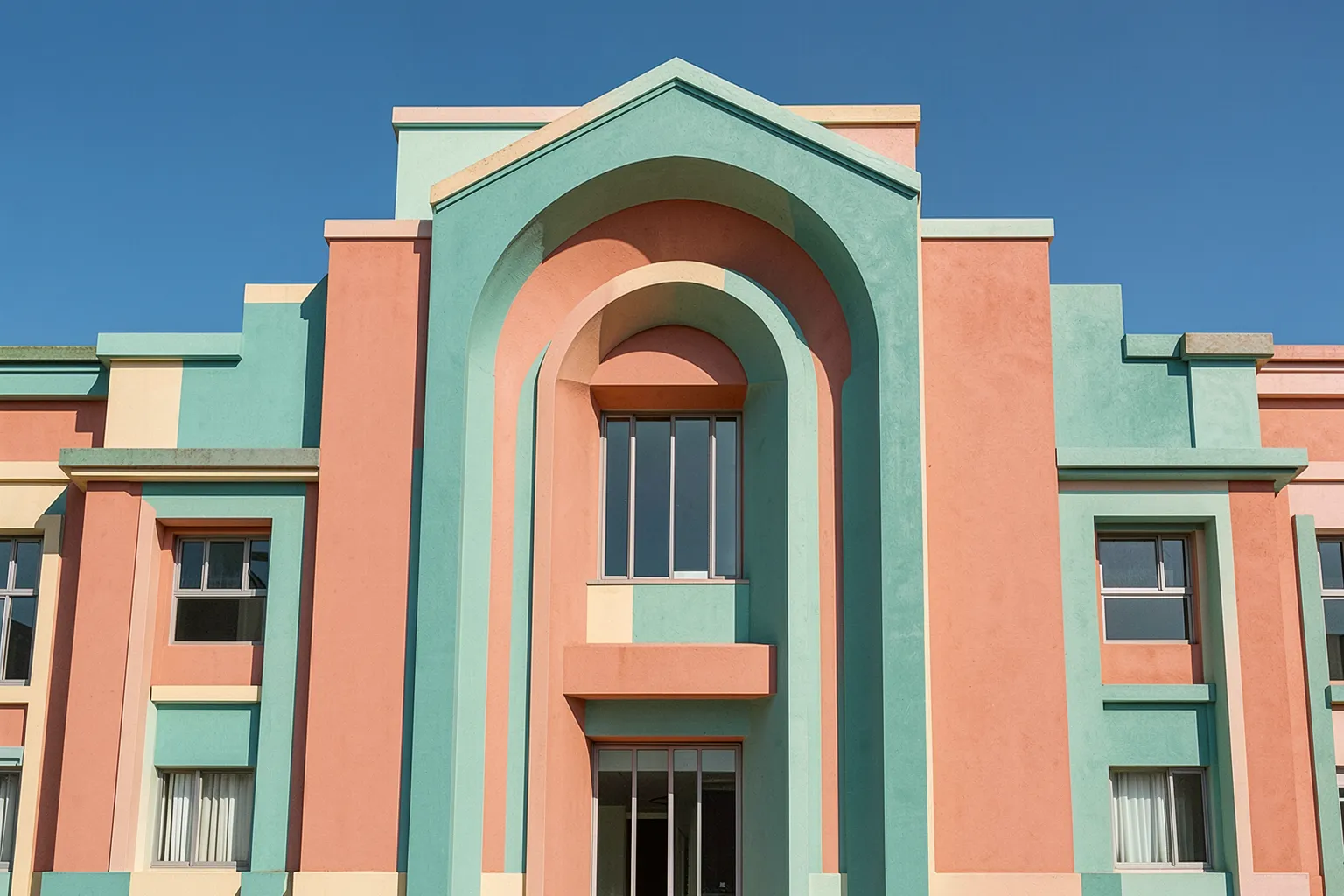
Robert Venturi hated the idea that a building should hide what it meant. “Less is a bore,” he wrote in 1966, flipping Mies van der Rohe’s famous line on its head. For twenty years after that, architects piled on color, columns, broken pediments and winking historical quotation. Then the glass-box revival of the 1990s buried the whole thing, and postmodernism became the style everyone loved to mock. Give an AI image model a prompt about it now and you get something strange: the jokes land again, because the machine doesn’t know it’s supposed to be embarrassed.
That turns out to matter. Postmodern architecture was always half about images — facades as billboards, buildings that signaled rather than whispered. A diffusion model trained on millions of pictures is, in a sense, the ideal reader of a style built to be photographed and recognized at a glance.
A style that argued with itself
The canon is small and loud. Michael Graves wrapped the Portland Building (1982) in salmon, teal and oversized keystones, and critics called it a jukebox. Philip Johnson topped the AT&T Building in Manhattan (1984, now the Sony tower) with a Chippendale pediment, as if the skyscraper were a highboy dresser. Charles Moore built the Piazza d’Italia in New Orleans (1978) out of neon, stainless steel and Roman orders rendered in stucco — a classical ruin that looked like a stage set, because it basically was.
Venturi and Denise Scott Brown gave the movement its theory in two slim books, Complexity and Contradiction in Architecture and Learning from Las Vegas. Their big idea was the “decorated shed”: a plain box with a communicative front, as opposed to the “duck,” a building whose whole shape is the sign. Most AI renderings of postmodernism, left to their own devices, produce ducks. They can’t resist making the entire structure shout.
Where the model gets it right
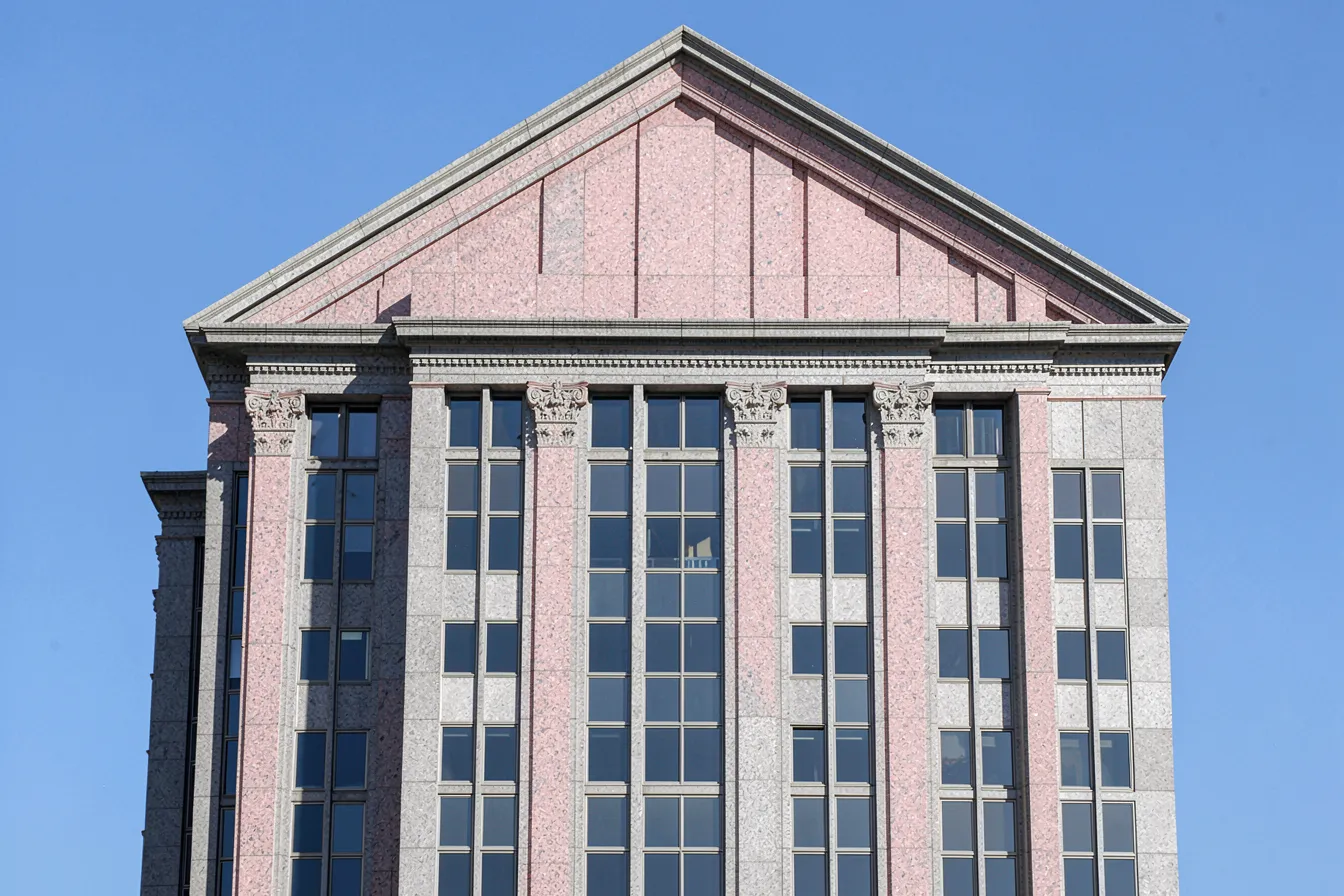
Color is the easy win. Postmodernism ran on a palette the modernists would have found vulgar — mint, ochre, dusty pink, primary red used without apology — and image models reproduce that mood instantly. Ask for a 1980s civic building with a pink-and-grey facade and a stepped silhouette, and you’ll get the flavor of Graves on the first try. The model has seen Portland, it has seen the Humana Building in Louisville, it has seen a thousand suburban offices that copied them badly.
Massing is the second thing it handles well. Postmodern buildings love symmetry, a strong central axis, and a clear top-middle-bottom split borrowed from classical columns. Those are exactly the compositional habits diffusion models fall into anyway. Give the prompt a word like “axial” or “tripartite facade” and the geometry snaps into place.
Quotation is where it gets interesting. The style quoted history — a pediment here, a Serlian window there, a keystone blown up to cartoon size. The model quotes its training data the same way, grabbing a fragment of a temple and gluing it onto a 1985 office block. The method is uncannily close to what Moore and Graves were actually doing by hand. It’s borrowing, recombining, playing dumb about scale on purpose.
Where it falls apart
Irony doesn’t render. The best postmodern buildings are jokes you have to be in on — Johnson’s dresser-top skyscraper is funny because you know the rules it’s breaking. An AI doesn’t know the rules, so it breaks them at random and the result reads as noise instead of wit. You get a broken pediment that isn’t broken for any reason, an arch that leads nowhere and means nothing.
Detail logic is the other failure. Real postmodernism was precise about its references — a specific Doric order, a particular Palladian proportion, misused deliberately. Models blur all of that into a generic “classical-ish” mush. Columns taper the wrong way. Keystones float free of the arches they’re supposed to lock. Up close, the ornament stops making structural sense, which is the one thing even the most ironic architect never let slide.
Prompting it on purpose
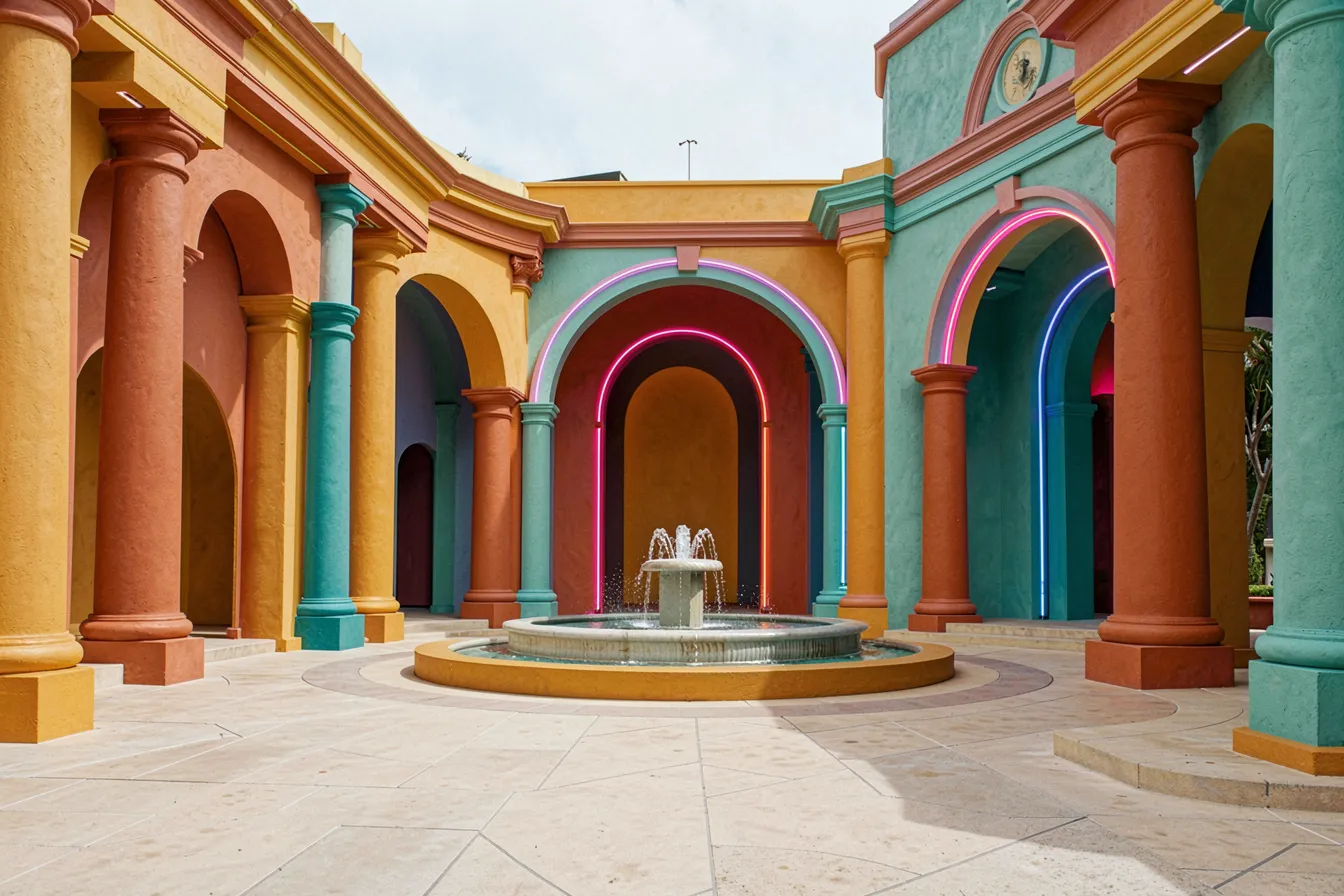
If you want convincing postmodernism out of a model, name names. “In the style of Michael Graves” does far more than “postmodern building,” because the training data clusters tightly around the famous examples. Pin the decade — early 1980s — and the palette follows. Ask for “stucco and polychrome” rather than “colorful,” and you steer away from the neon-soaked version the model defaults to.
Composition cues help most. Words like “frontal,” “billboard facade,” “oversized keystone,” “stepped roofline” and “classical order in flat pastel” push the model toward the decorated shed and away from the duck. Then fight its instinct to overdo it: adding “restrained, single gesture” against all that ornament usually produces something a real architect might have drawn.
Why bother reviving it
Postmodernism is having a quiet second life. A generation that grew up after the 1990s backlash finds the color and the humor genuinely refreshing, and the heritage world is now fighting to save the very buildings critics once wanted demolished — Britain listed several postmodern landmarks in the 2010s. AI tools let designers test that vocabulary fast, generating fifty variations of a pink civic facade before lunch, keeping the one that works.
The deeper fit is philosophical. Venturi wanted buildings that were “both-and” rather than “either-or” — able to hold contradiction, to be serious and silly at once. That’s a fair description of what these models do when they collage a temple front onto an office park. The machine stumbles into postmodernism’s central move without being told. Whether that’s homage or accident, the pictures are worth making.
Curious what a model does with your own building ideas? Try a few postmodern prompts and see where the machine surprises you at ai-art-designer.com.
Images: AI-Designed
Dieser Beitrag ist auch verfügbar auf:
 English