
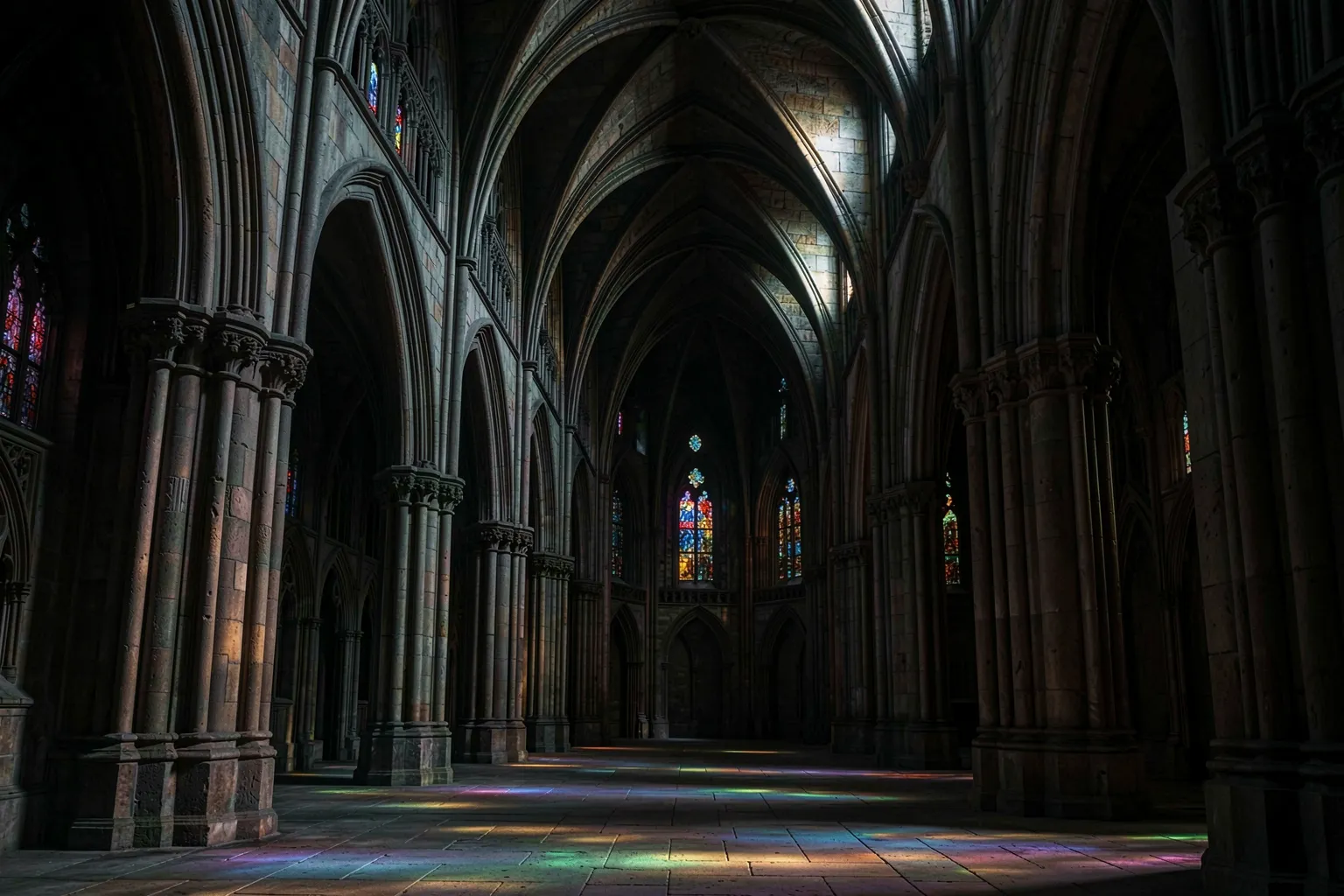
Point an image model at the word “cathedral” and it almost always reaches for the Gothic. Pointed arches. Ribbed vaults climbing out of sight. Stone lace where a wall should be. The style is nearly 900 years old, and yet it remains the default shape of the sacred in the machine’s imagination. That says something about Gothic Revival — the 19th-century movement that dragged medieval building back into fashion — and it says something about what AI finds easy to copy and hard to understand.
Gothic Revival was never a neutral style. When Augustus Pugin published Contrasts in 1836, he wasn’t proposing a look. He was arguing that pointed arches were morally better than classical columns — that a Christian society owed itself a Christian architecture, and that the smokestacks of industrial England were a spiritual failure made visible. Charles Barry handed him the new Houses of Parliament to decorate, and Pugin filled every inch with tracery, wallpaper, inkwells, and umbrella stands, all pointed, all bristling with meaning. Feed that to a diffusion model and you get the bristle without the belief.
What the machine gets right
The surface, mostly. And the surface of Gothic is spectacular, so this is no small thing. Ask for a Gothic Revival library and the better models will give you clustered colonnettes, foliate capitals, a hammerbeam ceiling, light falling through stained glass in colored bars across the floor. The ornamental vocabulary is dense and consistent, which is exactly the kind of pattern these systems absorb well. Crockets, finials, quatrefoils, cusped arches — they show up in the right places more often than not.
Scale reads convincingly too. Gothic works by making you feel small, and a good prompt pushes the vanishing point up near the top of the frame so the vaulting disappears into shadow. That verticality is the whole emotional engine of the style, and the models have clearly seen enough of Cologne Cathedral and Westminster to fake it well.
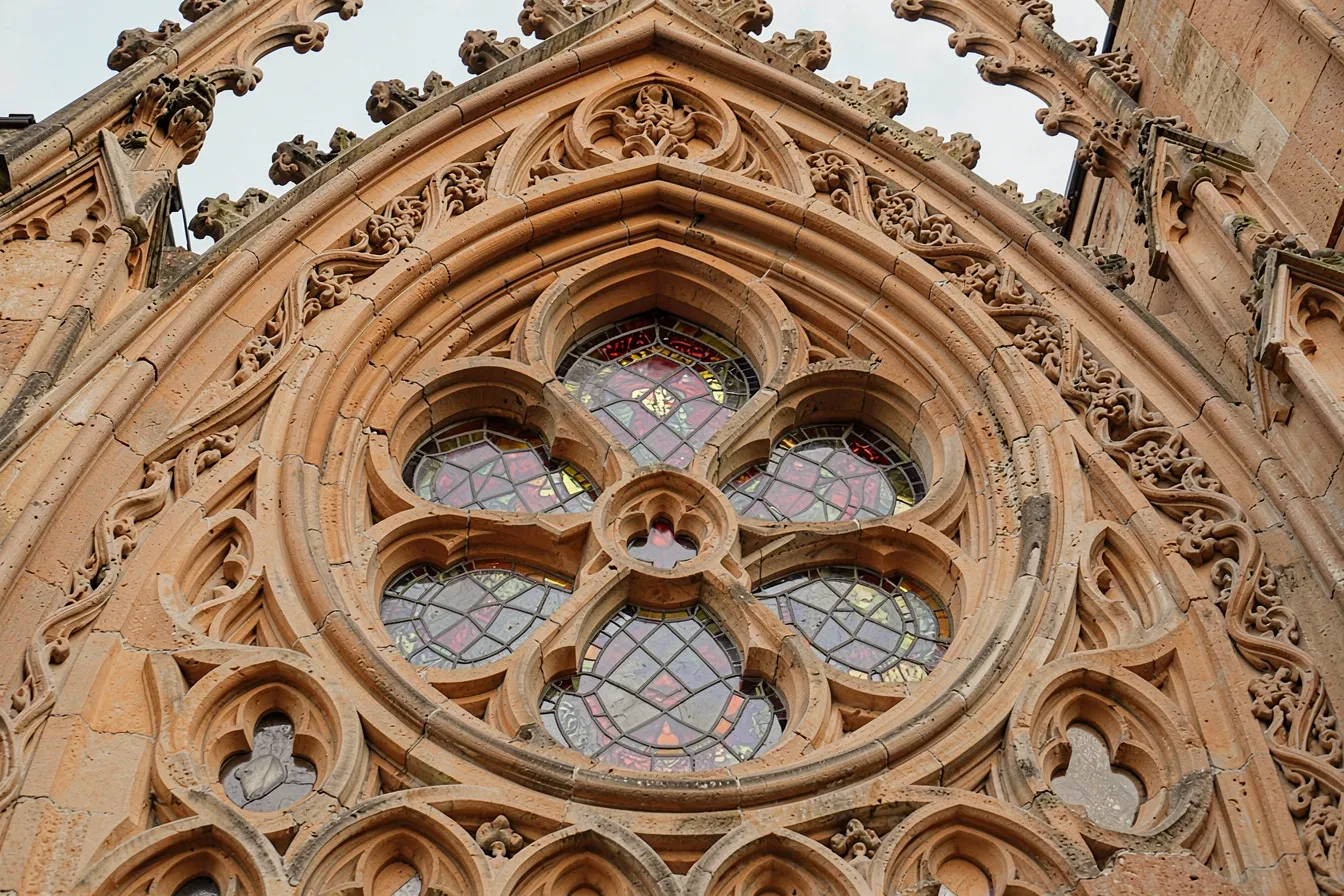
Where it gets interesting is the Revival part specifically, as opposed to the medieval original. Nineteenth-century Gothic was richer, cleaner, and frankly more confident than most of the real medieval fabric it imitated. Gilbert Scott’s Midland Grand Hotel at St Pancras is redder, sharper, and more theatrical than any genuine 14th-century building — it’s Gothic performed for a railway age. AI tends to land in exactly this register. The output usually looks less like Chartres and more like a Victorian architect’s fantasy of Chartres, which is historically correct in a way nobody programmed on purpose.
Where it falls apart
Structure. Real Gothic is a force diagram you can walk through. The flying buttress exists because the vault pushes outward and something has to shove back; the pointed arch exists because it directs load more steeply than a round one. Every bit of drama is doing a job. The machine knows none of this. It draws buttresses that lean against nothing, pinnacles that would snap off, tracery that dissolves into noise if you look at a window too long. Zoom into the stonework and the ribs stop meeting at the keystone — they just blur past each other, carrying no weight because in the model’s world there is no weight.
Text and symbol go the same way. Gothic buildings are covered in legible meaning — saints with their attributes, bestiary carvings, inscriptions, heraldry. AI renders a gargoyle as a vague lumpy animal and a stained-glass saint as a smear of robes with a melted face. The iconographic program that made a cathedral readable to an illiterate congregation is precisely the layer the model can’t reconstruct, because it never learned that the figure holding a gridiron is Saint Lawrence. It learned that cathedrals have colorful windows with people-shaped blobs in them.
Why designers use it anyway
Because for mood work and early concepting, surface is most of what you need. A production designer building a dark-academia interior, a game studio blocking out a cathedral level, an album cover that wants menace and grandeur — none of these require a structurally sound building. They require the feeling of one, fast, in forty variations. Gothic Revival is almost ideal for this. It’s instantly recognizable, it carries heavy emotional freight, and the models have an enormous amount of reference to draw on.
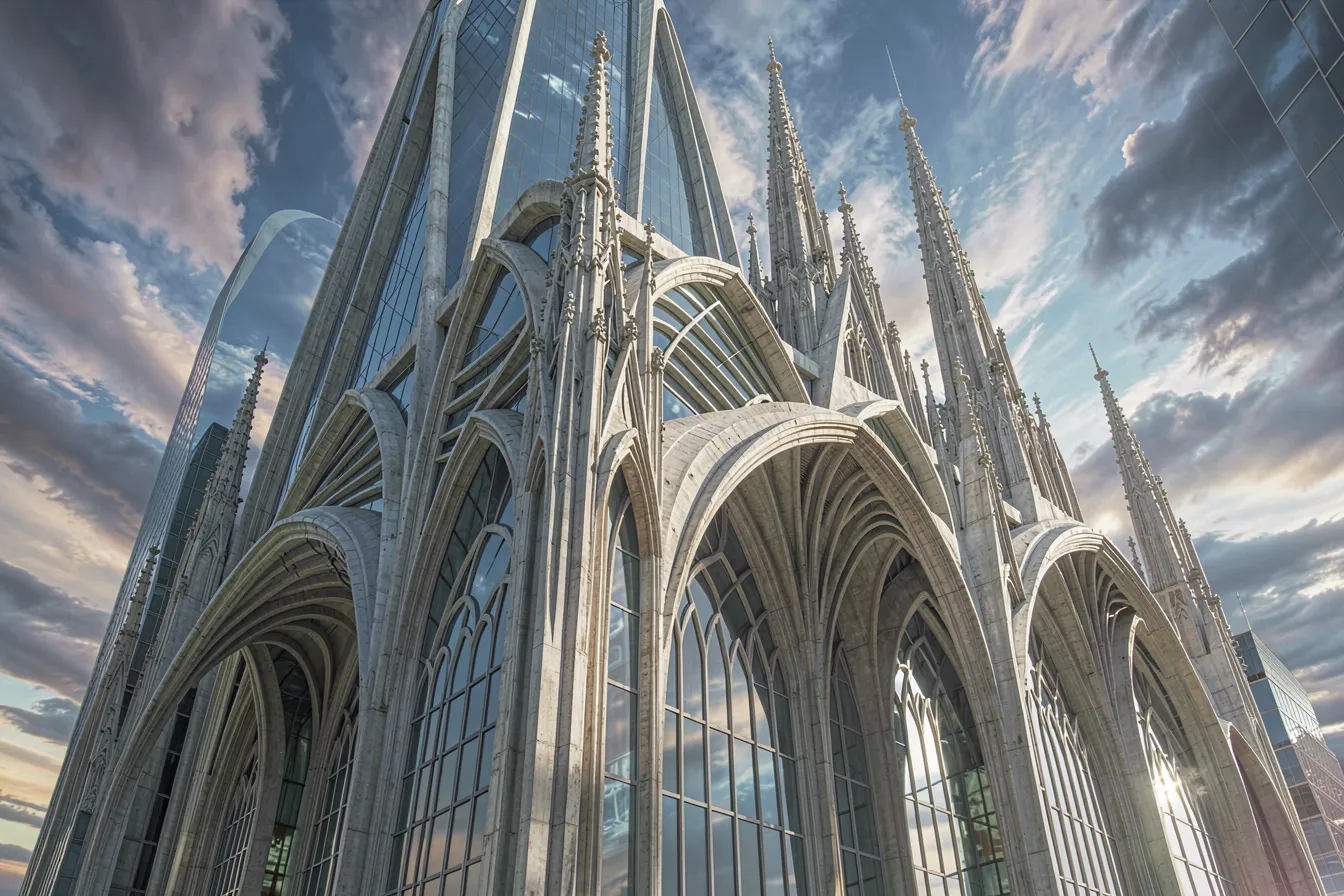
There’s a second, sneakier use. Gothic Revival was itself a remix — the Victorians cherry-picking French, English, and Italian medieval forms and fusing them into something new. That makes it a forgiving target for AI, which is also a remixing machine. Prompt a model to cross Gothic tracery with a modern glass tower and it doesn’t choke the way it might on a stricter style; it finds the seam and runs with it, because hybridity is baked into the Revival’s DNA. Some of the most convincing AI architecture I’ve seen lately is exactly this: neo-Gothic skins stretched over contemporary volumes, spires on skyscrapers, ribbed vaults in concrete. Ridiculous, and often gorgeous.
Ruskin’s objection, updated
John Ruskin, Gothic Revival’s loudest champion, hated machine-made ornament. In The Stones of Venice he argued that the roughness of hand-carved Gothic was the point — the visible labor, the mason’s imperfect judgment, the humanity in the chisel marks. A perfectly regular machine-cut leaf was, to him, a dead thing. He would have had opinions about diffusion models, and they would not have been kind.
But the irony cuts both ways. AI ornament isn’t regular — it’s wildly, organically irregular, full of half-formed shapes and happy accidents. In a strange sense it’s closer to Ruskin’s “savageness” than the laser-cut CNC stonework that passes for Gothic restoration today. The machine can’t carve a true quatrefoil to save its life, and that failure gives its output a hand-made wobble Ruskin might have grudgingly recognized. He’d still object. He’d just have to update the argument.
A style that survives bad copies
Gothic has been badly copied for 800 years and lost nothing. Every age gets the Gothic it deserves — the Victorians got moral earnestness, Hollywood got horror, the 1990s got a nightclub aesthetic. AI is just the newest copyist, and like all the others it reveals more about itself than about the style. It shows us a system that can mimic awe but not engineering, ornament but not meaning, the shadow of the cathedral but never the math holding it up.
For anyone making images, that’s a usable tool, not a flaw — as long as you know which half you’re getting. Want to see what a flying buttress wants to become in a machine’s dream? Try your own Gothic Revival prompts at ai-art-designer.com and watch where the stone holds and where it dissolves.
Images: AI-Designed
Dieser Beitrag ist auch verfügbar auf:
 English