

In 1960, a small group of Japanese architects declared that buildings should live. They called their movement Metabolism, and they imagined cities that grow, shed, and regenerate like organisms. Kisho Kurokawa, Kiyonori Kikutake, and their peers designed towers made of swappable capsules, megastructures that could sprout new limbs, and floating platforms that flexed with the sea. Most of these dreams never left the drawing board. Now generative AI revives them, testing how a sixty-year-old vision meets today’s design tools.
What Metabolism Actually Proposed
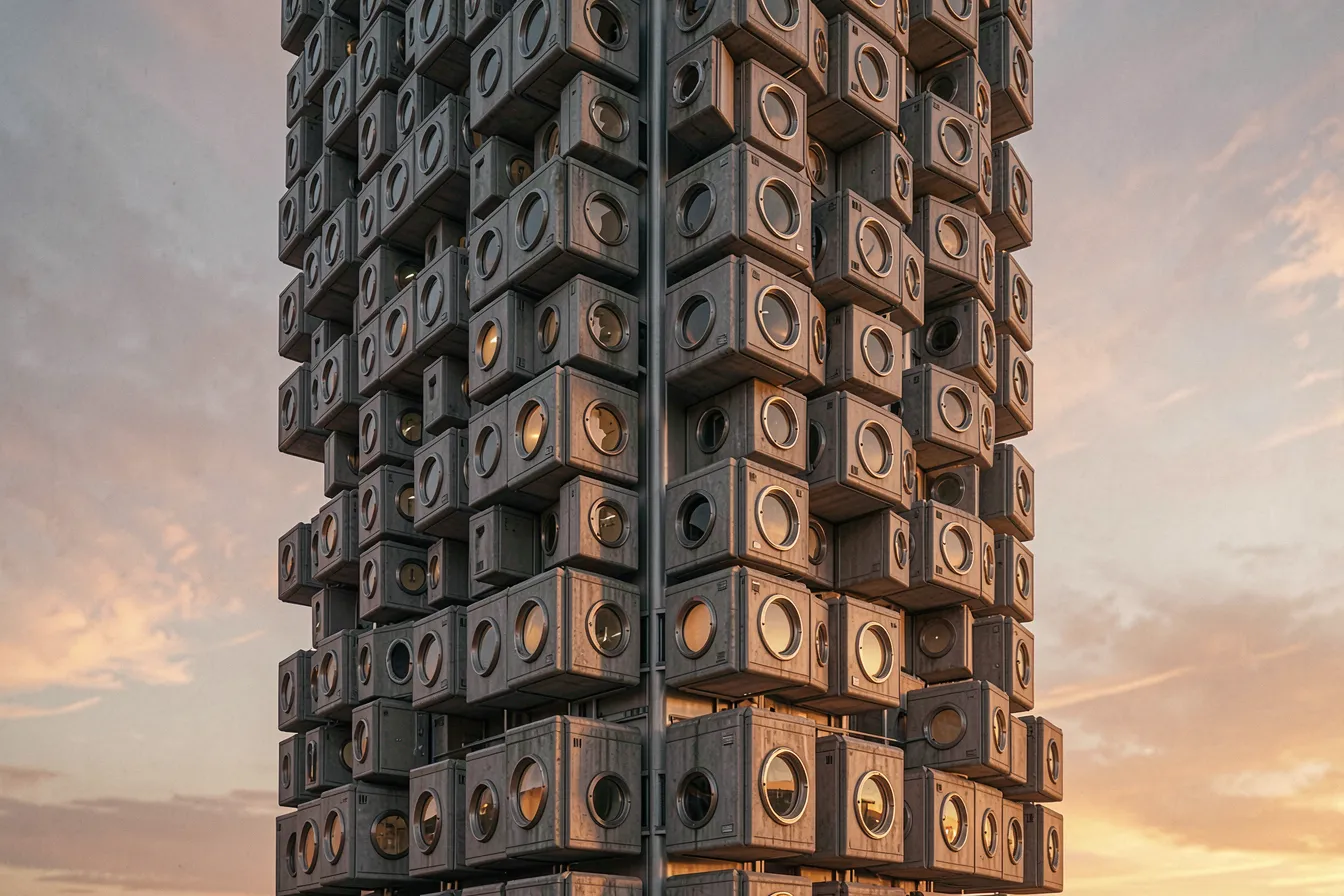
Metabolism rejected the static monument. Its architects treated a building as a frame plus interchangeable parts. You bolt fresh units onto a permanent spine, then unbolt the worn ones later. Kurokawa’s 1972 Nakagin Capsule Tower captured the idea perfectly. Each pod measured barely ten square meters, yet the tower promised endless renewal through replacement.
The movement also thought at city scale. Kikutake sketched marine cities that could drift and expand. Others proposed towers that branched upward like coral. These plans fused biology, engineering, and raw optimism. They asked one bold question: what if a city never finished growing?
Why AI and Metabolism Speak the Same Language
Generative models thrive on modular thinking, and Metabolism ran on modules. When you prompt a diffusion model for capsule towers, you tap a logic the model already understands. It composes, recombines, and varies units at speed. The style rewards that talent.
AI also handles the “what if” that Metabolism loved. Designers can ask a model to grow a tower fifty stories taller, then re-clad it in living moss, then flood its base for a marine district. Each render arrives in seconds. The old architects drew these mutations by hand across years. Today a studio explores hundreds of variants before lunch.
- Repetition with variation. AI populates a spine with pods that differ just enough to feel alive.
- Rapid mutation. One prompt tweak regrows a whole megastructure in a new direction.
- Biological texture. Models blend concrete, steel, and organic surfaces that Metabolists only described in words.
What the Renders Reveal
Feed a model Metabolist references and something striking happens. The results push past nostalgia. They show capsule towers wrapped in solar skin, marine cities crowned with vertical farms, and transit hubs that branch like river deltas. AI does not merely copy Kurokawa. It extends his grammar into materials and climates he never saw.
The images also expose the movement’s weak spots. Endless growth looks thrilling in a render, yet it raises hard questions about waste, cost, and human scale. A tower of a thousand identical pods can feel less like a home and more like a filing cabinet. Good AI work sits with that tension instead of hiding it.

From Fantasy to Working Method
Practicing studios now treat AI-Metabolism as a real ideation tool, not a gimmick. A designer starts with a structural spine, generates a field of capsule options, then curates the best few for engineers to test. The model handles breadth; the human enforces judgment, budget, and code. That division plays to each side’s strength.
Educators use the pairing too. Students prompt Metabolist cities, then critique what the machine gets wrong about daylight, circulation, and comfort. The exercise sharpens their eye faster than any lecture. They learn to argue with an image, not just admire it.
A Living Style, Finally Alive
Metabolism always aimed at motion, growth, and renewal. Its architects lacked the tools to show that life at full speed. Generative AI supplies the missing engine. It lets us watch a capsule city mutate, adapt, and reinvent itself in real time. The movement that dreamed of living buildings finally has a medium that moves.
Want to see classic architectural movements reborn through AI? Explore more style deep-dives and generate your own at ai-art-designer.de.
Images: AI-Designed