
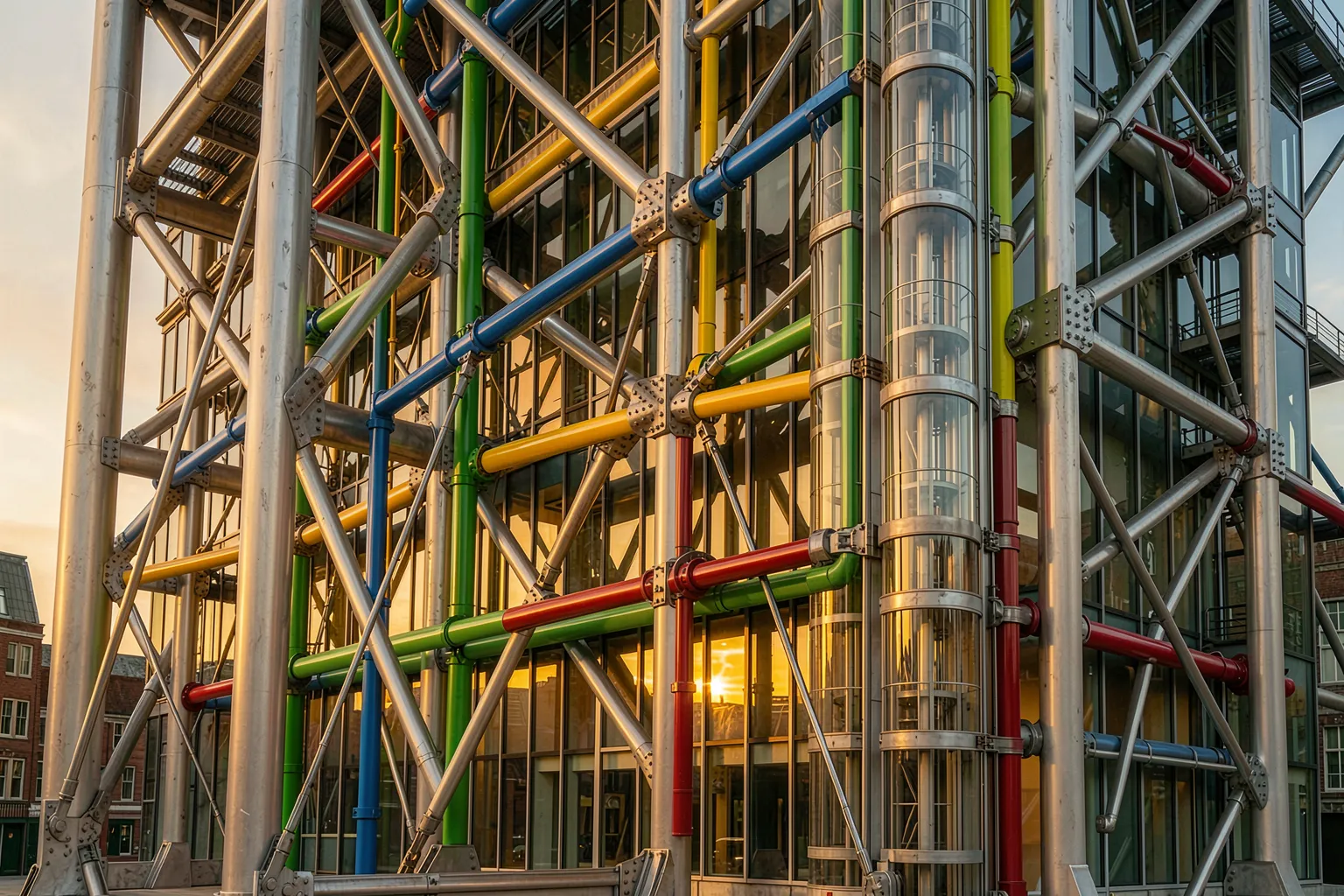
High-Tech architecture made a promise most styles never dare to make: show everything. Put the ducts on the roof, run the water pipes down the facade in green, hang the elevators off the side in glass tubes. The building wears its guts like a badge. So there’s a real tension in asking a generative model to render it, because the whole point of High-Tech was that nothing is faked. And a diffusion model fakes everything.
That tension is exactly why the style is worth feeding to AI right now. The results are seductive, often gorgeous, and quietly dishonest in a way that tells you something about both the architecture and the tool.
A style built on showing the work
High-Tech grew up in Britain and continental Europe in the 1970s, when Richard Rogers and Renzo Piano won the competition for the Centre Pompidou and turned a Paris museum inside out. Structure, ducts, escalators, electrical runs — all of it moved to the exterior, color-coded: blue for air, green for water, yellow for electricity, red for movement. The idea was partly practical (free up the interior, make services easy to swap) and partly a provocation. Buildings had spent centuries hiding their machinery behind stone. This one bragged about it.
Norman Foster’s HSBC headquarters in Hong Kong took the logic further, hanging floors from external masts so the ground plane could stay open. Rogers’ Lloyd’s of London put the staircases, lifts and toilet pods in six towers around a central atrium, so the office floors could change without touching the core. Michael Hopkins, Nicholas Grimshaw, Jean Nouvel in his cooler moments — a generation treated exposed steel, cast nodes and tension cables as the honest grammar of a modern building.
The look reads instantly: silver and gray, bolted joints, diagonal bracing, a lot of glass, the occasional primary-color accent on a pipe. It photographs beautifully. Which is the first clue to why AI likes it so much.
Why diffusion models find it easy — and that’s the problem
Ask a current model for “High-Tech architecture, exposed steel structure, glass curtain wall, external service ducts, Pompidou-style” and you’ll get something striking on the first try. The style has a strong visual signature and a deep training set — decades of architectural photography, all those magazine spreads of the Pompidou and Lloyd’s shot at golden hour. The model has seen the surface a thousand times.
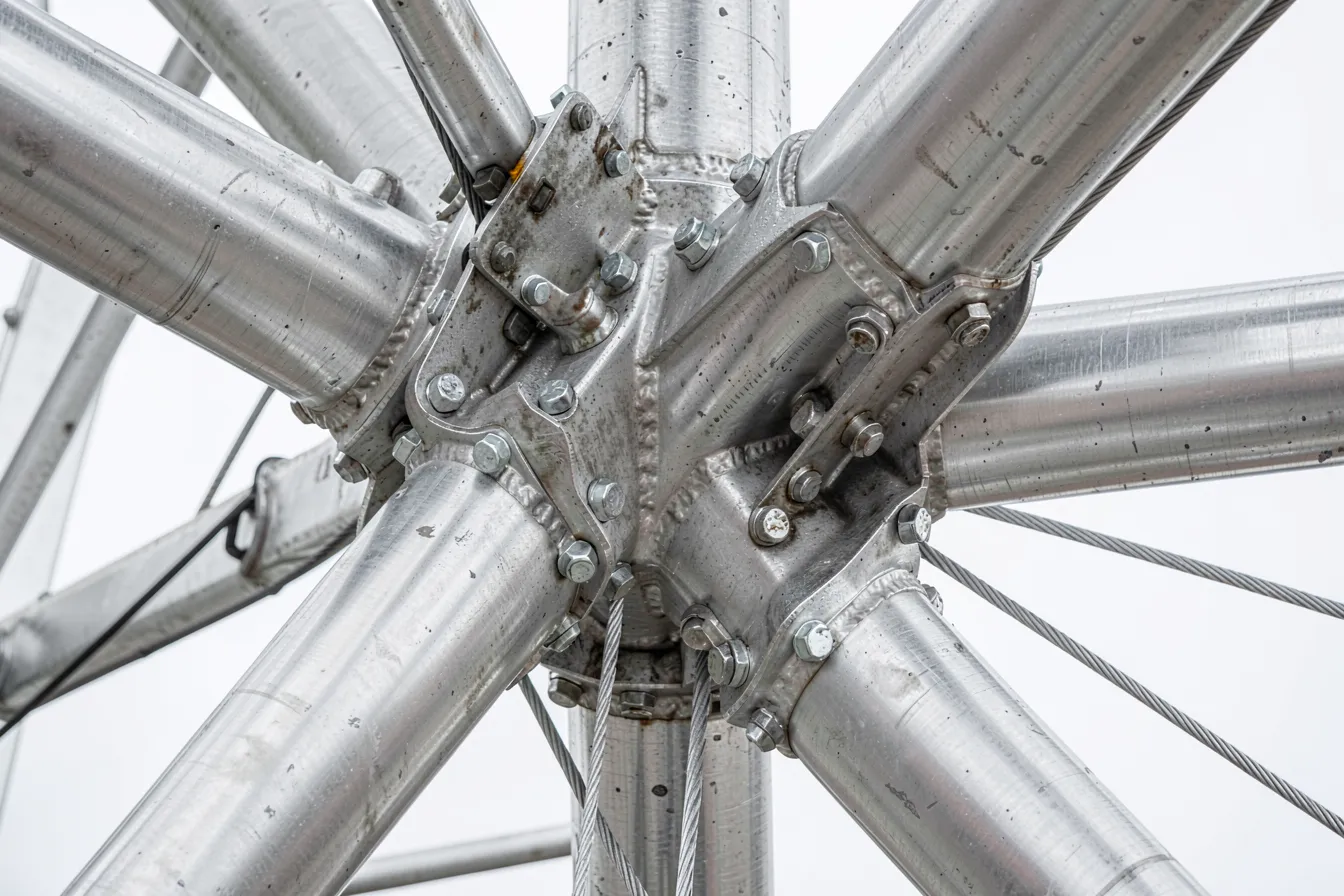
But it has never seen the logic. High-Tech is an engineering argument made visible. Every truss carries a load, every cable is in tension for a reason, every colored pipe actually goes somewhere. A diffusion model renders the appearance of a load path without any of the physics underneath. You get trusses that support nothing, cables that sag where they should pull, bolts scattered like decoration across a beam that would never need them. The joints are the giveaway. Real High-Tech lives or dies on its cast-steel nodes — the points where six members meet and the engineer has to solve the force diagram. AI renders those nodes as lumps. Beautiful lumps, confident lumps, but structurally nonsense.
So the style that was invented to tell the truth about how a building stands up becomes, in a model’s hands, pure costume. The ducts are painted on. That’s not a small irony. It’s the whole story.
What it’s genuinely good for
None of this makes the output useless. It makes it a different kind of useful. A few jobs where AI-rendered High-Tech earns its keep:
- Mood and massing early on. Before anyone draws a real truss, a designer can generate forty variations of a High-Tech transit hall or market shed to find a silhouette worth developing. The fakery doesn’t matter yet; the feel does.
- Teaching the vocabulary. Students learning why the style looks the way it does can generate and then critique — spotting the cable that’s clearly wrong is a better lesson than copying a photo that’s right.
- Editorial and brand imagery. A magazine or a studio that wants the idea of transparent, machined modernity — not a buildable drawing — gets exactly the sheen it’s after.
- Reviving the unbuilt. The 1970s and 80s are littered with High-Tech schemes that never got funded. AI can give them a plausible photographic afterlife, the way it already does for Futurist and Metabolist paper projects.
The common thread: these are all jobs where you want the look and you’re not pretending it’s structurally resolved. Trouble starts when someone forgets the difference.
How to prompt it so it holds up
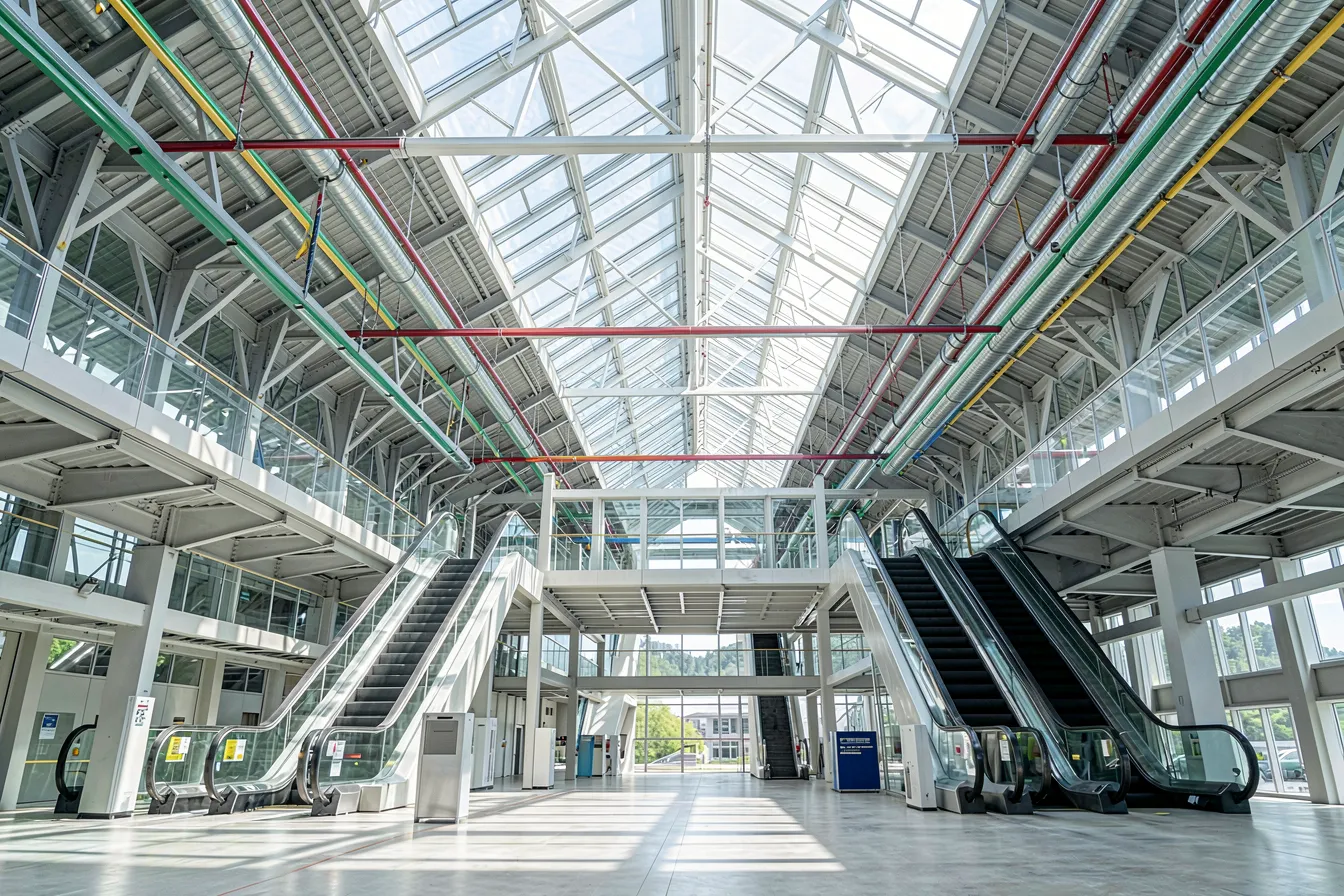
A few habits push the output from generic-glass-box toward something that reads as real High-Tech. Name the architects and buildings — “in the manner of Rogers’ Lloyd’s of London” does more than a pile of adjectives. Specify the color-coded services explicitly, because the model will drop them otherwise and give you a plain curtain wall. Ask for the external circulation — the glass lift tubes, the exposed escalators — since those are what separate the style from ordinary mid-century modernism. And push for a clear structural rhythm: “regular steel bays, visible diagonal bracing, exposed cast-steel nodes.”
Then fix the joints by hand. Inpainting the node points, or running a structural reference through ControlNet, gets you closer to something an engineer wouldn’t laugh at. You’re not making it true — you’re making the lie more careful. For most uses, careful is enough.
Honest machines, honest fakes
There’s a neat symmetry here that the style’s founders might have enjoyed. High-Tech argued that a building should admit what it is: a machine for occupying space, services and all. Generative AI, at its best, should probably do the same — admit it’s producing a picture, not a plan. The failures only become dangerous when the image gets passed off as resolved design.
Render High-Tech with that in mind and the results are some of the most convincing architectural images a model can make. The steel gleams, the pipes glow, the glass does its thing in the late sun. Just remember that the truth-telling style, run through a truth-indifferent tool, produces a very pretty lie — and that knowing it’s a lie is what makes it worth looking at.
Want to build your own High-Tech scenes and push past the generic glass box? Try the generators and editing tools at ai-art-designer.com.
Images: AI-Designed
Dieser Beitrag ist auch verfügbar auf:
 English