
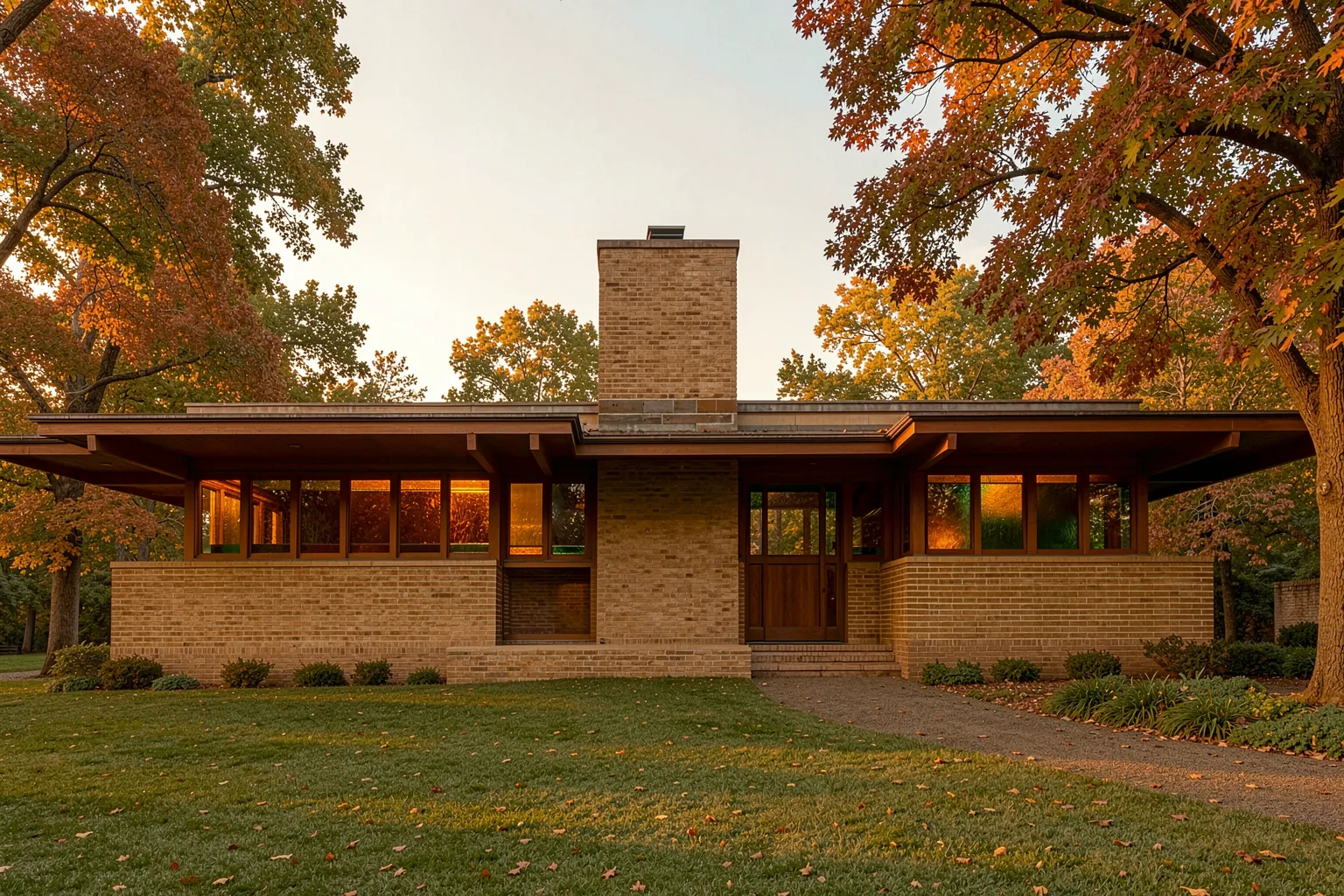
Frank Lloyd Wright hated the box. He said so plainly. By 1901 he was already tearing the American house apart at the corners, pushing its roof down low and stretching it sideways until it looked like it grew out of the Illinois dirt. The Prairie School that followed — the Robie House, the Willits House, Unity Temple down the road in Oak Park — gave the Midwest a style of its own instead of a borrowed European one. More than a century later, text-to-image models are being asked to draw in that same horizontal grammar. The results are telling, both for what the machine gets right and for the one thing it keeps fumbling.
Prairie is a hard style to fake. It runs on proportion and restraint, not ornament, so there is nowhere for a model to hide a weak guess. That makes it a good test of whether an AI actually understands a style or just memorized its surface.
What the Prairie style actually is
Strip it to rules and you get a short list. Long, low rooflines with deep overhanging eaves. Strong horizontal bands — Roman brick laid with raked horizontal joints and flush vertical ones, so the eye slides along the wall. Ribbon windows in continuous runs, often with slim art-glass patterns in gold, green and amber. A central masonry chimney anchoring an open plan that flows room to room. Earth tones, ochre, and the browns and sea-greens Wright pulled straight from the landscape.
The point of all this was never decoration. Wright wanted the building to belong to its site, to sit in the prairie the way a boulder sits in a field. That is the idea a model has to grasp, and it is harder than any single visual trick.
Where the models land it
Ask a current diffusion model for “Prairie School house, deep eaves, Roman brick, ribbon windows, autumn” and the good ones give you something genuinely convincing. The horizontality reads correctly. The cantilevered roof throws a real shadow. Art glass glints in the window bands. Trained on thousands of Wright photographs and the Prairie imitators that followed, the model has clearly absorbed the look.
It also nails the mood, which matters more than people admit. Prairie photographs tend to be shot at golden hour, low sun raking across the brick, trees half-framing the house. Models reproduce that lighting almost by reflex, and the warmth does a lot of the persuading. On the surface, the style transfers cleanly.
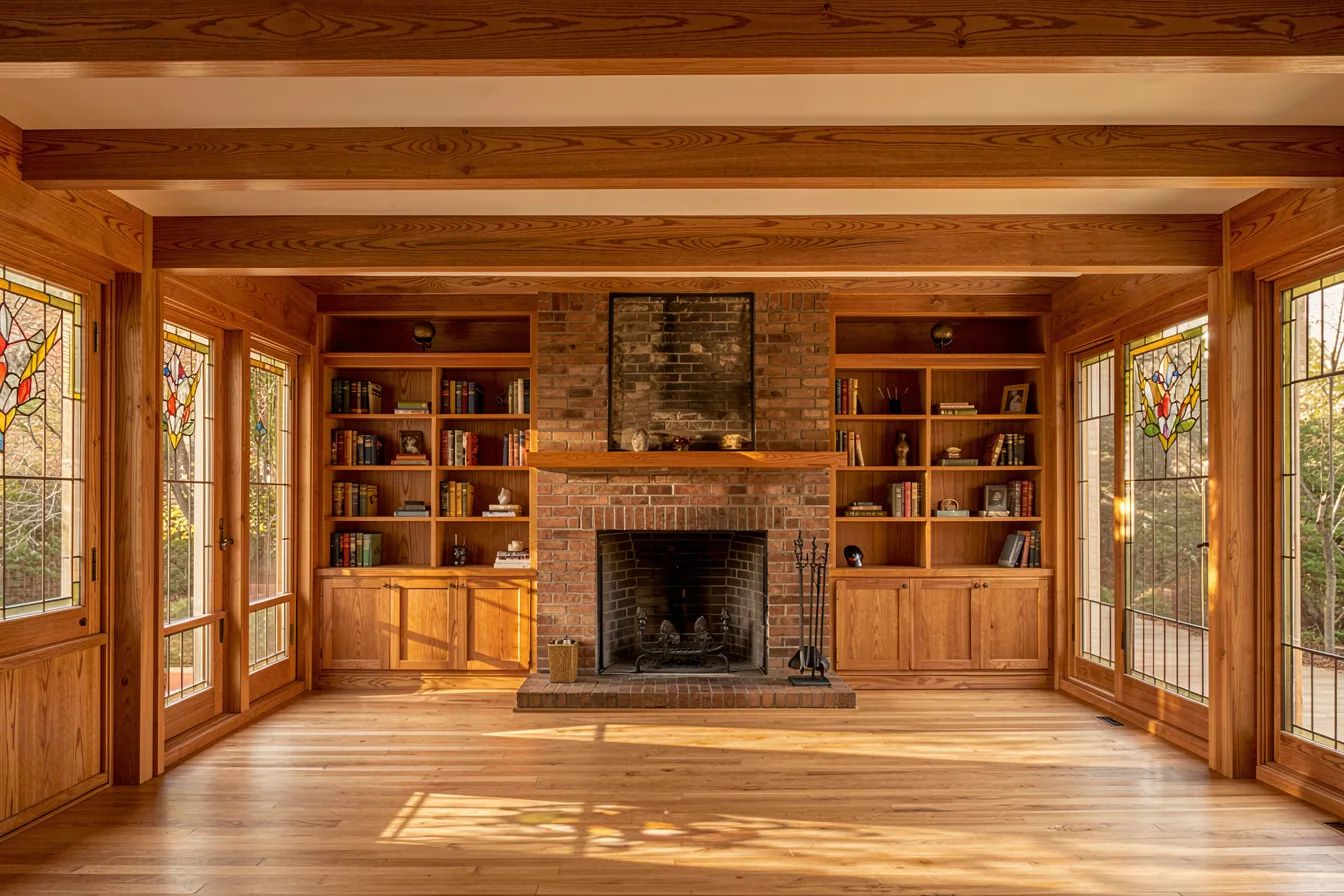
Interiors come out well too. Ask for a Prairie living room and you get the banded wood trim, the built-in cabinetry, the leaded-glass screens, a low ceiling opening toward a taller hearth zone. The horizontal wood lines that Wright used to knit a room together survive the translation. For a concept image or a mood board, this is already useful.
Where it quietly breaks
Look closer and the cracks show. The first is structural honesty. Wright’s cantilevers are real engineering — the roof reaches out because the masonry core holds it back, a physical argument you can trace. The model draws the effect of a cantilever without the logic. Eaves float a beat too far. A roof plane hangs with no visible means of support. To a casual eye it passes; to anyone who has stood under those eaves, it reads as a drawing of Prairie rather than a Prairie building.
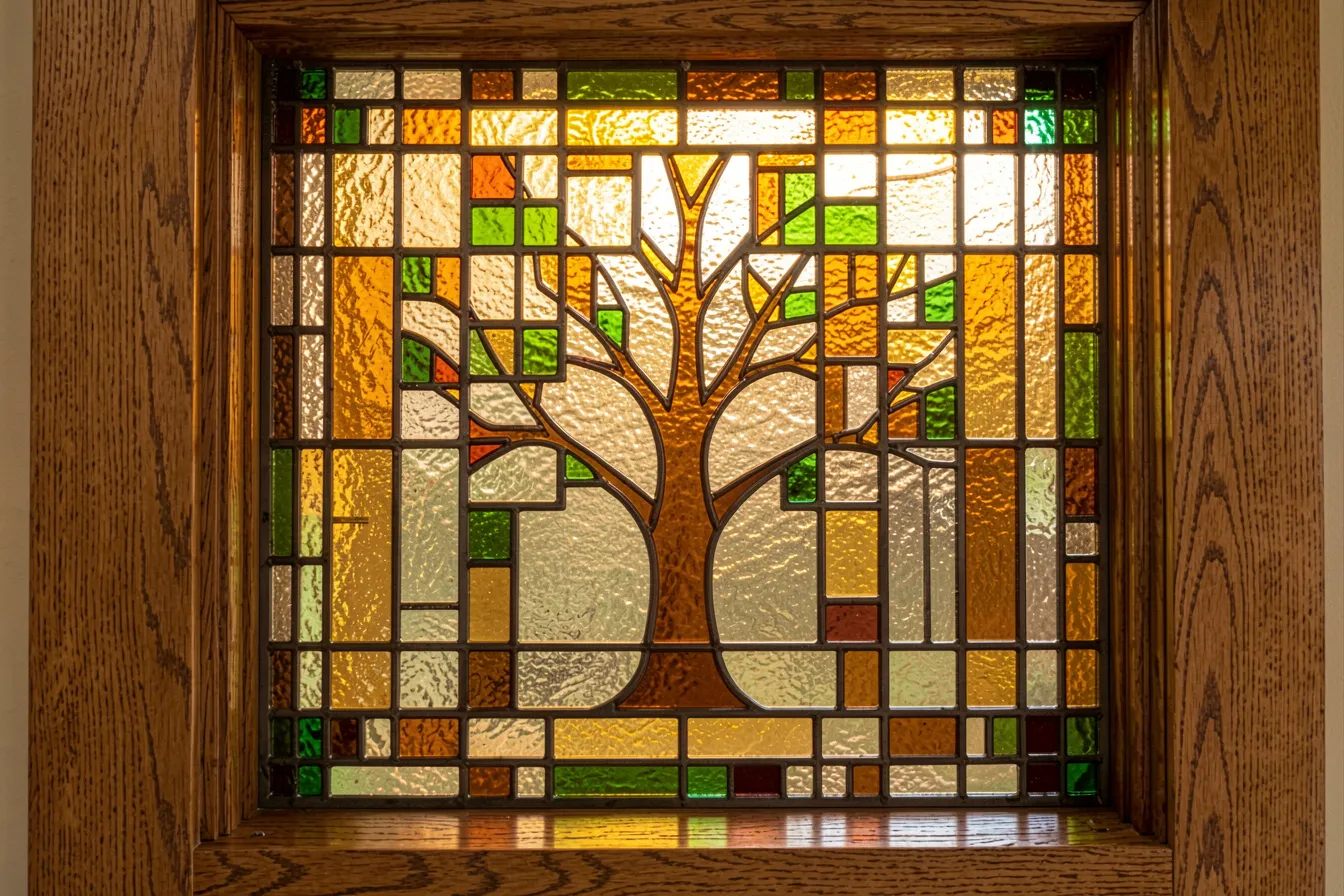
Art glass is the second tell. Wright’s window patterns are strict geometry — the “Tree of Life” at the Martin House, for instance, is a disciplined grid of rectangles and small colored squares, every line deliberate. Models love to turn that into pretty mush: symmetrical-ish lattices that shimmer nicely and mean nothing, lines that don’t resolve, motifs that wander. The vibe is there. The rigor is gone.
The third problem is the deepest, and no prompt fixes it. Prairie architecture is about a building answering a specific place. A model has no site. It renders a house against a generic pretty backdrop, so the defining relationship — this structure, this ground — is exactly what it cannot supply. You get a Prairie-shaped object dropped onto a stock meadow. Handsome, rootless, and missing the entire point.
How to prompt it better
You can push the quality up a lot with specifics. Name materials, not moods: “Roman brick with raked horizontal mortar joints,” “copper-capped deep eaves,” “continuous ribbon of casement windows.” Give the model a real reference era — “1905 Prairie School, Oak Park” — to pull it away from generic modern-ranch drift. For interiors, ask for “banded quarter-sawn oak trim” and “built-in bookcases flanking a brick hearth.”
Control tools help where prompts can’t. Feed a plain sketch of the massing through a structure-guided pipeline and you can force the long low roofline instead of hoping for it. Hand the model a flat elevation and inpaint the window grid by hand to recover the art-glass geometry it won’t invent on its own. The machine is a fast, fluent renderer; you still have to supply the architectural judgment.
Why bother rendering a 1905 style with 2026 tools
Because Prairie is having a quiet revival, and the imagery feeds it. Architects reaching for warmth, horizontality and a connection to landscape — the exact things glass-box modernism tends to skip — are pulling Prairie cues into new houses. AI lets them spin up fifty façade studies in an afternoon, test an eave depth, swap brick tones, see a ribbon window run before anyone drafts a wall. As a sketching partner for a known language, it earns its keep.
The limits are a feature, not a bug. The model handing you proportion and warmth for free, then falling down on structural logic and sense of place, draws a clean line around what was never really about style in the first place. Wright’s buildings work because someone thought hard about how a roof holds itself up and how a house meets its ground. That thinking is still yours to do. The machine just draws faster.
Want to try a Prairie study of your own? Build and refine one with the tools at ai-art-designer.com and see how far horizontal restraint gets you.
Images: AI-Designed
Dieser Beitrag ist auch verfügbar auf:
 English