
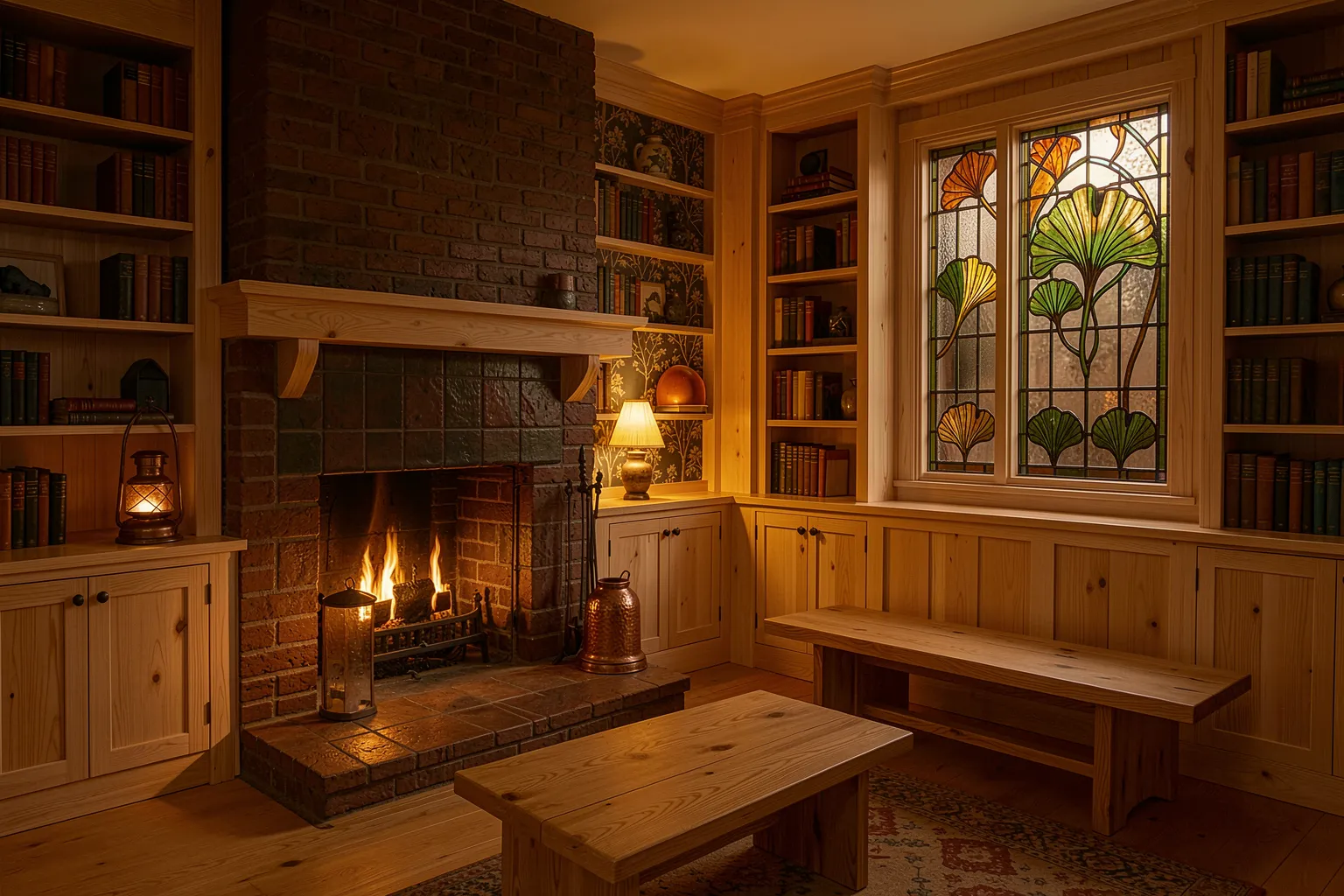
William Morris would have hated this. The man who told the Victorian middle class to “have nothing in your houses that you do not know to be useful, or believe to be beautiful” spent his life fighting the machine. Factory furniture, printed imitation carving, wallpaper stamped by the mile — he saw all of it as a lie about how things get made. So there is a real joke in feeding “Arts and Crafts interior, hand-planed oak, Morris willow-pattern wallpaper” into an image model and watching a diffusion network, the most industrial image-maker ever built, hand you a room that looks lovingly hand-built.
Designers are doing exactly that. And the results are better than they have any right to be.
What the style actually asks for
Arts and Crafts is not a look you can fake with a filter. It came out of 1880s Britain as a reaction against cheap industrial goods, and its rules are about honesty, not decoration. Show the joinery. Use real materials and let them read as what they are. Quarter-sawn white oak with its tiger-stripe flecks. Hammered copper and blackened iron. Leaded glass with a stylized rose or ginkgo leaf, never a fussy flourish. Horizontal lines, low ceilings, a big hearth as the heart of the room. Gustav Stickley built a whole American industry on it and called his magazine The Craftsman; the Greene brothers took it to the extreme in the 1908 Gamble House, where every peg and cloud-lift bracket is deliberate.
That specificity is what trips up a lazy prompt. Ask a model for “cozy wooden interior” and you get a generic cabin. The movement has a grammar, and you have to speak it.
Where AI gets it right
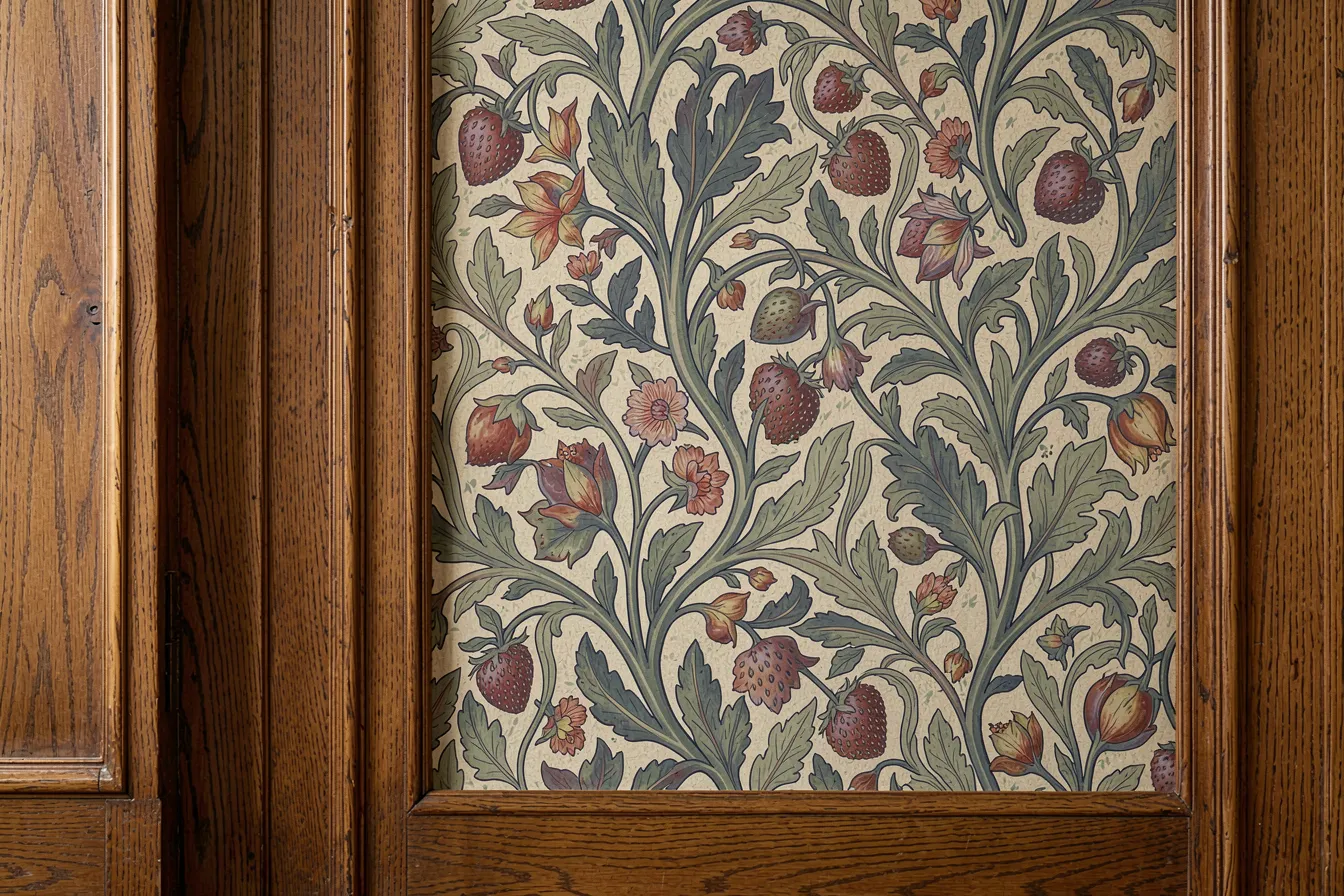
The surprise is texture. Current models render quarter-sawn oak with the flecking in the correct places — along the ray planes, not scattered like confetti. They understand that an Arts and Crafts chair is boxy and vertical-slatted, not a curvy Victorian antique. Feed in Morris’s actual patterns by name — Strawberry Thief, Willow Bough, Pimpernel — and the better models reconstruct the flattened, repeating botanical logic he borrowed from medieval tapestry. The repeat is often wrong by a craftsman’s standard, but the character survives.
Lighting helps too. The style loves warm, dim, amber rooms lit by mica-shaded lamps, and that is squarely in a diffusion model’s comfort zone. Golden light on dark wood is the kind of scene these systems have seen a million times. So a prompt that would look fake in a stark modernist render — all that moody glow — lands naturally here.
For a studio like AI Art Designer, this makes the style a genuinely useful one to generate. A client who wants a Craftsman living room can see twenty honest variations before anyone orders a single board of oak.
Where it falls apart
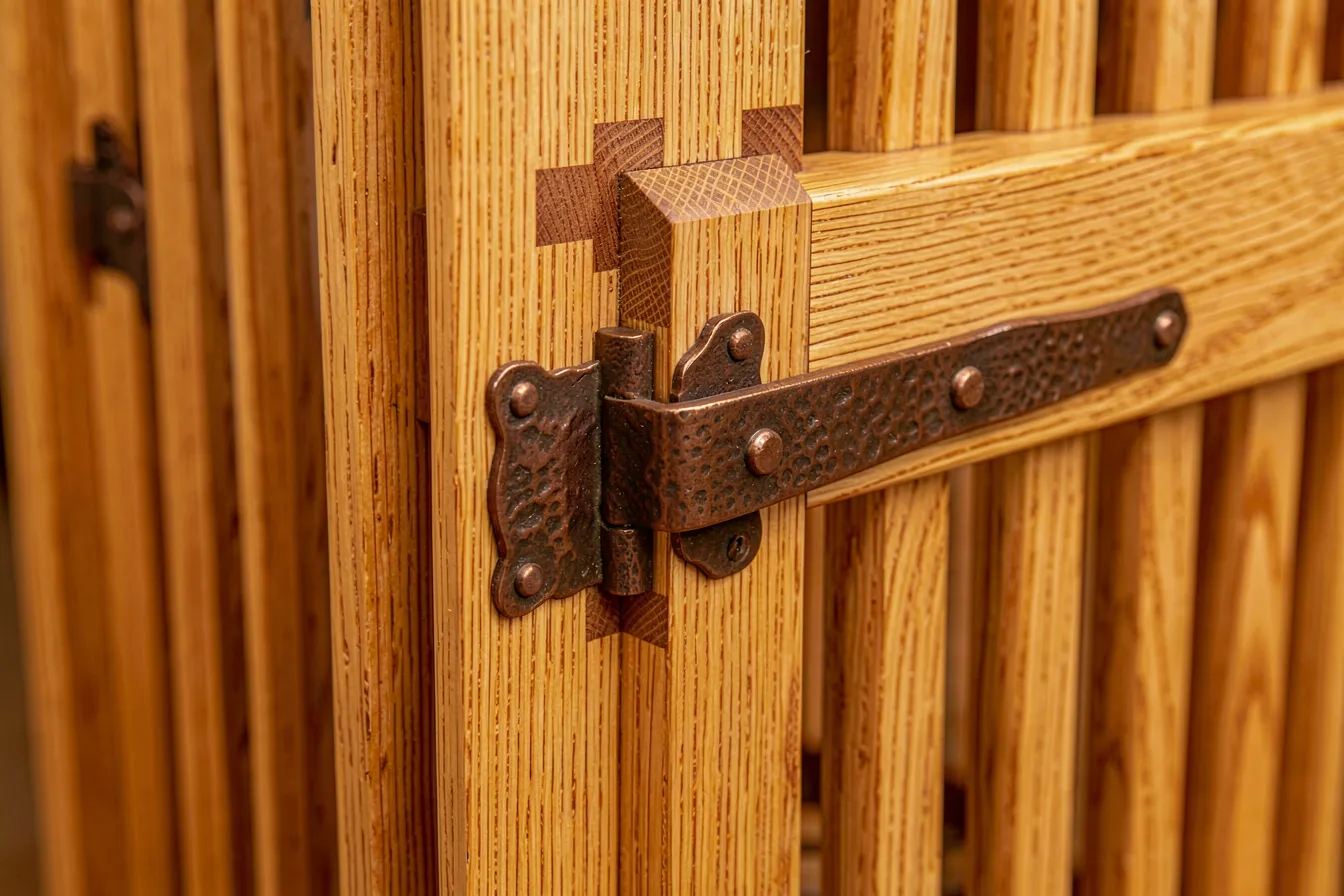
Joinery. Always the joinery. The whole philosophy of the movement lives in how two pieces of wood meet — the exposed mortise-and-tenon, the through-tenon with its little wedge, the finger joints the Greenes left proud of the surface. Models fake this beautifully from a distance and fall apart up close. Zoom in and a “tenon” turns into a painted-on rectangle that goes nowhere, a bracket that supports nothing, a peg floating a millimeter off the wood. For a style built on the truth of construction, a render that only pretends to be joined is the one failure that matters.
Hardware is the other weak spot. Hand-hammered copper hinges and strap pulls come out as generic metal blobs unless you push hard on the prompt, and even then the rivets rarely line up. Morris & Co would have sent it back.
None of this is fatal. It just marks the line between a mood board and a buildable drawing. AI nails the first and still can’t do the second.
The irony is the point
It is worth sitting with the contradiction instead of smoothing it over. The Arts and Crafts movement existed to defend the human hand against mechanical reproduction. Morris ran his firm partly as a protest. And here is the ultimate reproduction machine producing flawless images of hand-work it never touched.
But maybe that is less of a betrayal than it looks. Morris’s real enemy was not machines as such — he used printing presses and dye vats happily. His enemy was dishonest work: the factory pretending its stamped molding was carved. An AI render that openly says “this is a generated concept, not a built room” is honest about what it is. It is the render that pretends to be a photograph of real joinery that would have made him throw his hammer.
How to prompt it well
Three things separate a convincing Arts and Crafts render from a generic wooden room. Name the wood species and cut — “quarter-sawn white oak, fumed finish” — because the grain is half the style. Name a real pattern or designer, Morris or Stickley or Voysey, instead of asking for “floral wallpaper.” And describe the light as warm and low, from lamps rather than windows, because the amber glow does more work than any single object.
- Lean into the horizontal. Low furniture, wide hearths, long sightlines. The style sits down; it does not reach up.
- Keep ornament sparse and structural. One stylized motif, repeated, beats a crowded Victorian scene every time.
- Accept the joinery limit. Frame shots to suggest construction rather than zooming in on a joint the model can’t actually resolve.
Arts and Crafts was a hundred-year-old argument about how things should be made and who should make them. Running it through an image model doesn’t settle that argument — if anything it sharpens it. The render is gorgeous and it is a concept, not a chair. Want to see a Craftsman room built honestly in pixels before it is built in oak? That is exactly the kind of work AI Art Designer is built for.
Images: AI-Designed
Dieser Beitrag ist auch verfügbar auf:
 English