
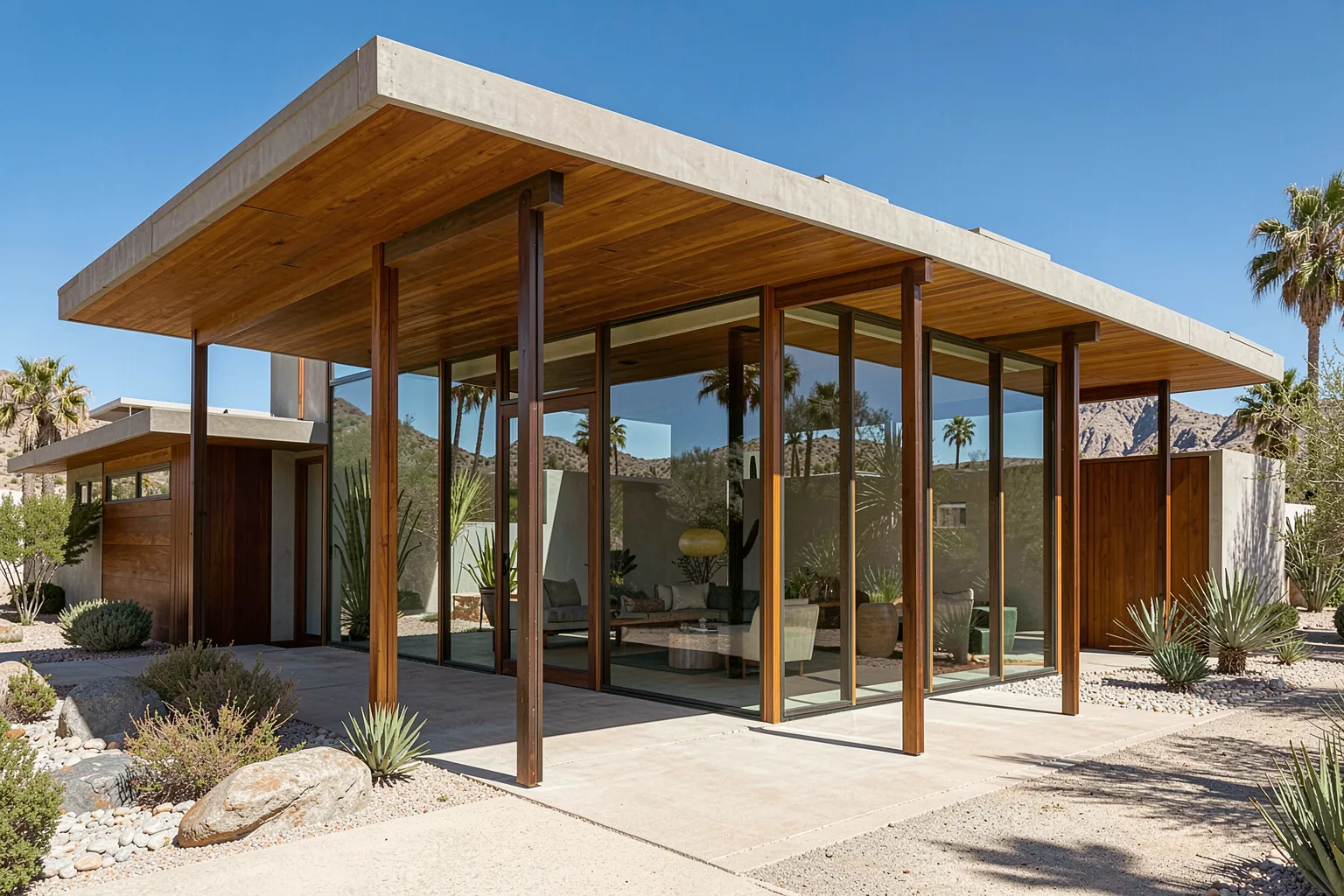
Ask any image model for a mid-century modern house and it will hand you the same picture: a low flat roof, a wall of glass, a kidney-shaped pool, and a sky the color of a tangerine at dusk. It looks right. It also looks like every other result, because the model learned the style from ten thousand real-estate listings and Julius Shulman reprints, then averaged them into a single glossy postcard. Mid-century modern is one of the easiest styles to summon from AI and one of the hardest to get honestly right.
That gap is worth sitting with. The style ran roughly from 1945 to 1969, and its best buildings were arguments, not moods. Richard Neutra’s Kaufmann House in Palm Springs pinned a glass pavilion to the desert floor. Pierre Koenig’s Case Study House #22 cantilevered a living room over the Los Angeles grid so hard it looked like it might tip. Charles and Ray Eames built their own home out of off-the-shelf steel and glass catalog parts, on principle. The look we now scroll past was downstream of real structural nerve.
Why the models speak this dialect so fluently
Training data explains most of it. Mid-century modern never left. Eichler tracts in the Bay Area still trade at a premium, Palm Springs runs a Modernism Week every February, and the Eames Lounge Chair has been in continuous production since 1956. So the web is saturated with clean, well-lit, well-tagged photographs of the style. A diffusion model fed that diet produces post-and-beam ranch houses on command, with the clerestory windows and the walnut credenza and the Nelson bubble lamp already in frame.
Furniture is where this gets specific. Ask for a mid-century living room and you reliably get a Saarinen Tulip table, a Noguchi coffee table, a Womb chair, maybe an Arco-style arc lamp leaning in from the corner. The model has seen these pieces thousands of times. What it has not done is understand them. It will give you an Eames lounge with the wrong number of back cushions, a Tulip base that melts into the carpet, a credenza with legs that don’t touch the floor. Close enough to feel authentic, wrong enough to annoy anyone who owns the real thing.
What AI gets wrong, and why it matters
The failures cluster around structure. Mid-century modern was built on honest engineering — exposed beams that actually carried load, cantilevers sized to real steel, posts on a real grid. AI reproduces the appearance of that logic without the logic. You get roofs that float with no visible support, beams that pass through glass and stop, cantilevers no engineer would sign. The eye reads “Stahl House” and the structure reads “impossible.”
Then there’s the Shulman problem. Julius Shulman’s 1960 photograph of Case Study House #22 — two women in a glass corner, the city lights spread out below — did more to sell this style than any building did. Models have absorbed that exact lighting: the blue-hour glow, the warm interior lamps, the long exposure city beneath. So they reach for it constantly. Every house ends up photographed at the same magic-hour moment, which flattens the style into a single cliché instead of a 25-year movement with real range, from austere Neutra to playful Palm Springs Googie-adjacent exuberance.
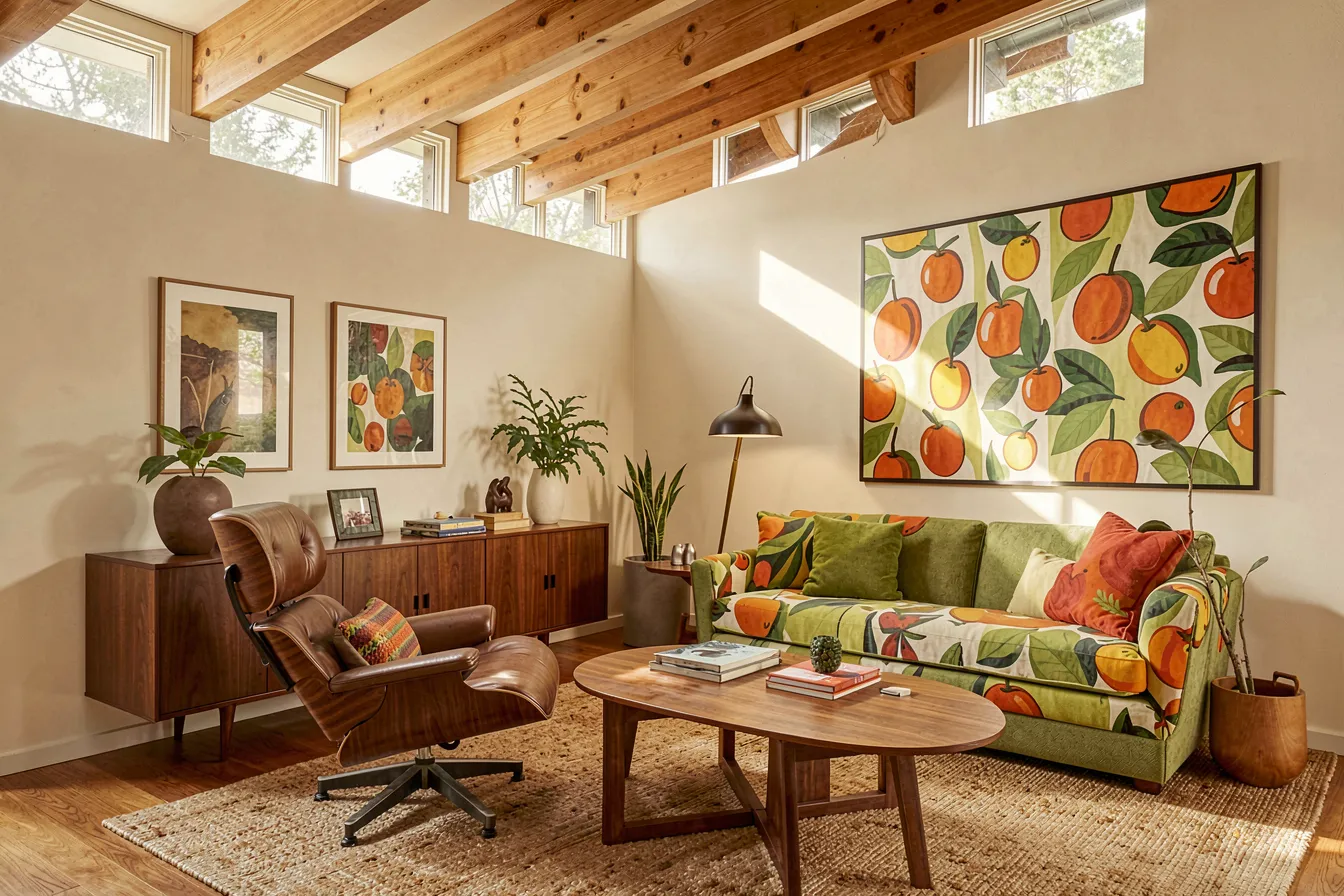
Color drifts too. Real mid-century palettes were braver and stranger than the AI default of white, walnut, and one mustard accent. Think Alexander Girard’s hot textiles, avocado and harvest gold kitchens, the chalky pastels of a Miami motel. The models sand all of that down toward a safe, Instagram-friendly neutral, because neutral is what the training images skewed toward.
Using it as a sketch tool, not an oracle
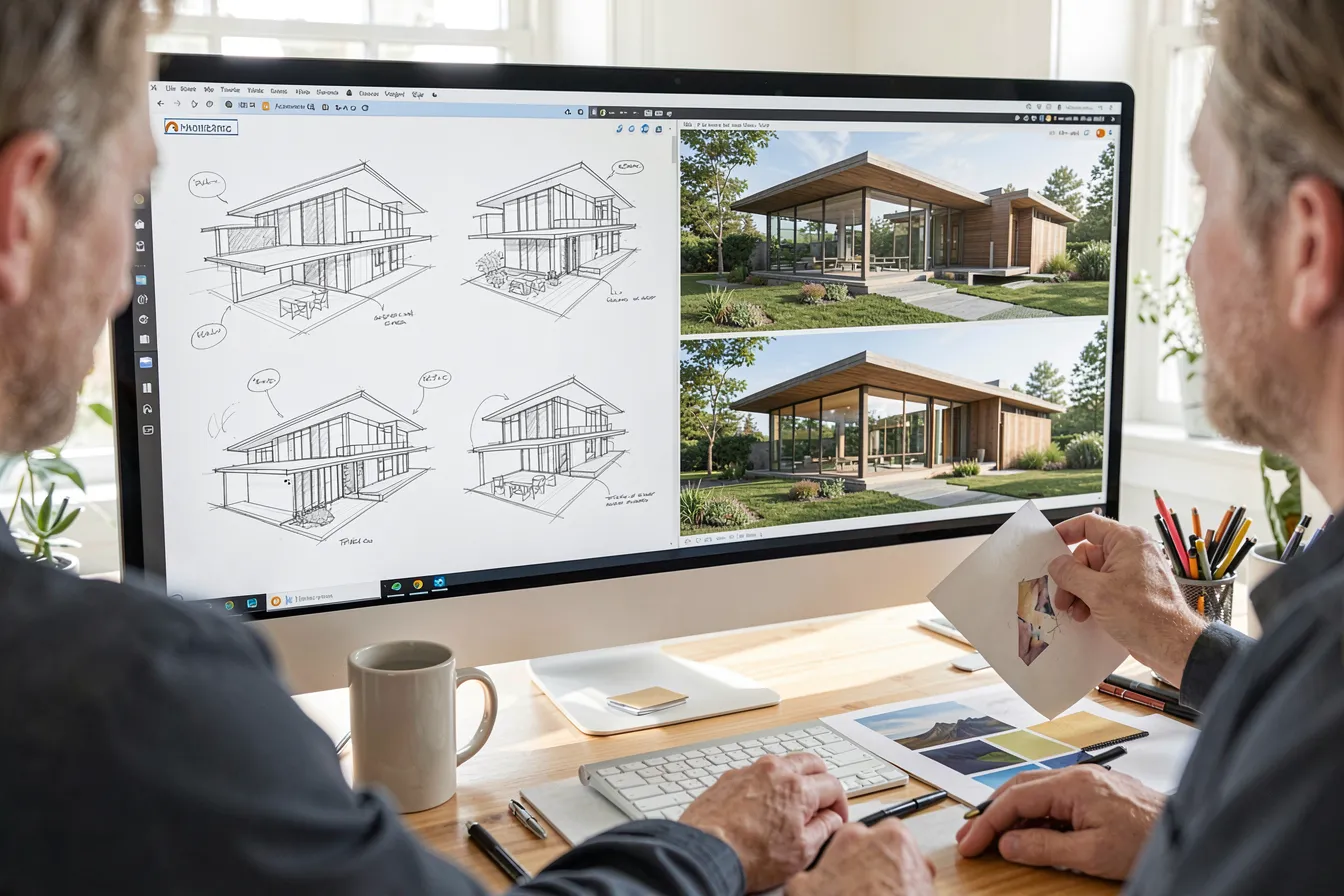
None of this makes the tools useless. It makes them junior collaborators. The designers getting real value out of AI on mid-century work treat it as a fast sketch pad for the fuzzy front end of a project — the stage where you’re testing twenty ideas and committing to none.
A renovator weighing what to do with a tired Eichler can generate a dozen variations on the atrium, the beam color, the clerestory glazing, in minutes, and walk into the meeting with pictures instead of adjectives. An interior stylist can test a Girard-bright palette against a quiet one before buying a single cushion. The point is not to trust the render — it’s to think out loud, visually, cheaply.
How to pull better mid-century modern out of a model
Specificity beats style words every time. “Mid-century modern house” gets you the postcard. Name the architect, the house, the material, the time of day, and the picture sharpens fast. “Post-and-beam living room, Douglas fir ceiling, clerestory windows, Alexander Girard textiles, late morning light, no sunset” steers the model away from its defaults and toward something that feels designed rather than scraped.
- Kill the sunset. Add “midday” or “overcast daylight” to break the Shulman twilight reflex and reveal the architecture honestly.
- Name real pieces sparingly. One or two correctly named designs anchor the scene; a shopping list produces clutter.
- Push the palette. Ask for avocado, persimmon, teal, or a Girard-inspired scheme to escape the default beige.
- Watch the structure. If a beam floats or a roof hovers, regenerate — don’t publish an engineering lie as a design idea.
- Pick an era within the era. Early austere modernism and late exuberant 1960s California are different animals; say which you want.
The style was never about the look
Here’s the quiet irony. Mid-century modern was a reaction against decoration for its own sake — form that followed structure, honesty about materials, democratic design you could actually buy. AI, left to its defaults, turns it back into pure surface: the vibe without the reasoning. The style becomes a filter.
The designers worth watching push the other way. They use the model to iterate on real spatial problems — how light moves through a clerestory, how a palette reads at noon versus dusk, whether an open plan actually flows — and throw away the renders that are only pretty. That’s the mid-century spirit, oddly enough: use the new tool, but make it earn its place.
Want to try reimagining a mid-century space, a design style, or an architectural idea with AI? Explore more on ai-art-designer.com and see what the tools can — and can’t — do for your next project.
Images: AI-Designed
Dieser Beitrag ist auch verfügbar auf:
 English